

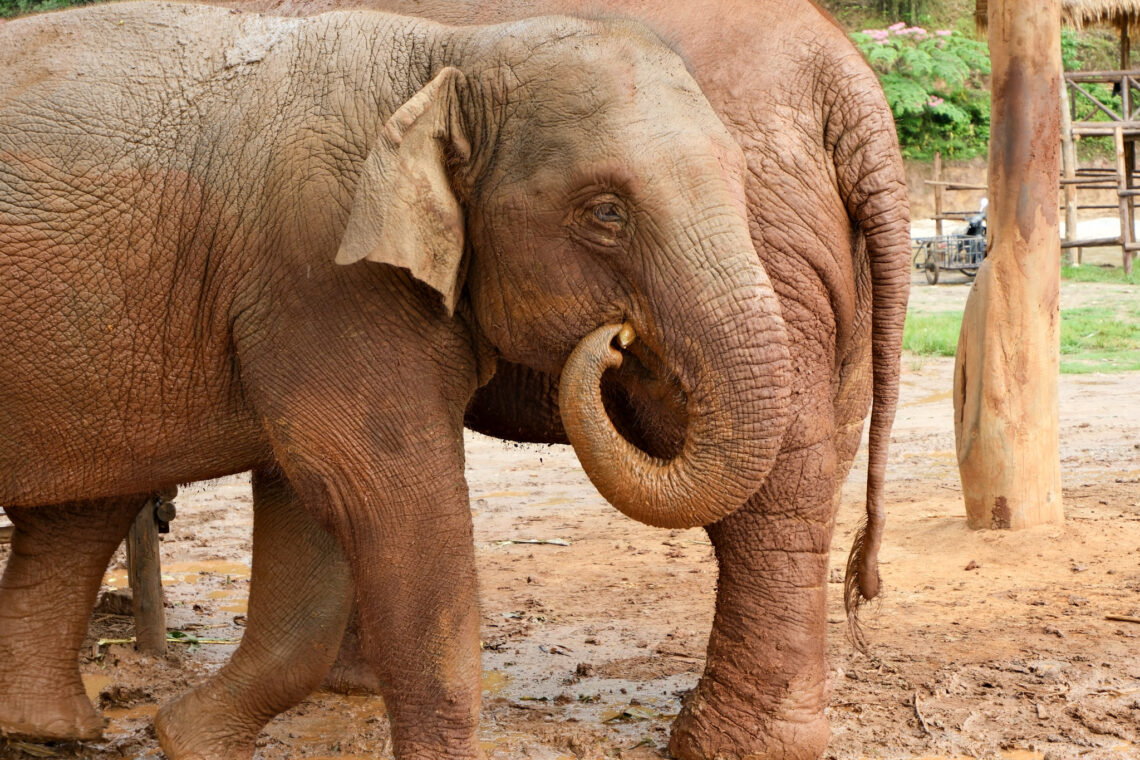
Elephant Nature Park: Ethical Elephant Sanctuary in Chiang Mai
If you’ve ever seen someone posing with a sedated tiger while clutching a can of Chang, you’ve probably rolled your eyes. Wildlife tourism is impossible to ignore in parts of Thailand, and while most of us would agree that tiger selfies are cruel and unnecessary, elephant tourism is much harder to unpick. Every “ethical elephant sanctuary” has its supporters and its critics, and it’s not always obvious who’s right or where the line is.
I almost didn’t visit Elephant Nature Park, and I almost didn’t write this post.
I’ve been vegetarian since I was 12 years old (and in late 90s Ireland, that was no mean feat), and a vegan since January 2020. Because of these long-held values, I don’t think animals exist for our entertainment, and the idea of paying to spend a day with elephants made me deeply uncomfortable.
At the same time, Elephant Nature Park has a reputation for rescuing elephants from logging, trekking, and entertainment, and the money from visitors helps to fund the work they do. As a result, I found myself caught between two ideas that both seemed true.
When a colleague I trust, and who knows I’m vegan, told me it had been the highlight of his trip to Chiang Mai, I decided to do some more digging. I spent time researching the park, reading both praise and criticism, and trying to decide whether visiting aligned with my own values.
So here’s my verdict before we get into details: I’m still undecided. Even writing this now, a few weeks on, I’m not completely at peace with my decision to visit Elephant Nature Park.
This isn’t going to be a perfectly polished post where I have all the answers, nor is it going to be a glowing review urging you to visit too. It’s going to be exactly what animal tourism is: shades of grey, nuance, and uncertainty. I’ll share what I saw and learned, and leave it to you to make up your own mind.
How Do We Define an Ethical Elephant Sanctuary?
The big question, right? If you go and Google “ethical elephant sanctuary” right now, you’ll find a bunch of options available to you, each offering something slightly different, each defending their “ethical” stance in different ways.
The trouble is, there is no universal definition. “Ethical sanctuary” isn’t a regulated term, and different organisations, charities, and animal welfare groups draw the line in different places.
That said, there are some common themes. If we look at guidance from organisations like PETA, WWF, and World Animal Protection, there are a handful of principles that come up again and again:
- No touching. Elephants are wild animals, not pets. Most animal welfare organisations agree that visitors shouldn’t be riding, bathing or handling elephants simply for the sake of the experience. The focus should be on observing natural behaviour rather than encouraging close encounters.
- No breeding. The primary role of an ethical elephant sanctuary should be to provide lifelong care for elephants that have already been rescued, not to breed more elephants into captivity unless there’s a genuine conservation need.
- Plenty of space. Wild elephants can travel many kilometres every day. While no sanctuary can perfectly recreate life in the wild, elephants should have enough space to roam, forage and choose where they spend their time rather than being confined to small enclosures.
- Socialisation with other elephants. Elephants are highly social animals that naturally live in matriarchal family groups. Where possible, rescued elephants should have opportunities to form social bonds with other elephants, while recognising that some may need to be kept separate because of past trauma or compatibility issues.
- No performances or other unnatural behaviours. Many rescued elephants have spent years being trained for entertainment using harsh methods. A sanctuary should allow them to behave naturally rather than asking them to paint, perform tricks or entertain visitors.
- Transparency. A reputable sanctuary should be open about where its elephants came from, how they’re cared for, and how visitor income contributes to their welfare.
On paper, these principles seem pretty straightforward. In practice, they’re much harder to apply because very few sanctuaries fit neatly into the “ethical” or “unethical” boxes. This is exactly what I was trying to work out before I booked Elephant Nature Park.
Why I Chose Elephant Nature Park
Ahead of my trip to Chiang Mai, I started looking at different elephant sanctuaries around the area. To be honest, they all claimed to be ethical in one way or another, which only made the decision more difficult.
Elephant Nature Park kept coming up, across travel blogs and discussion sites. Historically, they had previously allowed close up feeding and bathing experiences, which led to them being omitted from some “approved” lists. Those close-contact experiences have since been phased out. At the time I visited, Responsible Travel, an ethical tour auditing agency, lists ENP on their regularly updated “supported/not supported” list.
Founded by an elephant rights advocate, Lek Chailert, Elephant Nature Park focuses on rescuing elephants who were previously used for street begging, elephant riding, and circus shows. Ms. Chailert started rescuing elephants in the 90s, before opening ENP in 2003 as a permanent retirement home for them.
A rescue-first approach
The park says its mission is to rescue elephants from logging, trekking camps, and the entertainment industry, giving them a permanent home rather than training them for tourist experiences. The focus appeared to be on caring for elephants that had already suffered at the hands of humans, rather than creating demand for more captive elephants.
During my visit, my guide explained that the male and female elephants have entirely different sections of the park, which means they have no opportunity to breed. There was one young elephant with her mother, both of whom had been rescued together, but she was the only young elephant I saw – and in fact, many were 50-60 years old.
No Riding or Performances
This was the easiest box to tick. ENP doesn’t offer elephant rides, circus style shows or opportunities to watch elephants to perform tricks. The emphasis is on observing them behaving naturally, rather than entertaining visitors.
Education as Experience
One thing that appealed to me about Elephant Nature Park is that they seem to put a lot of effort into explaining each elephant’s story, the realities of the logging and trekking industries, and they don’t shy away from explaining the lasting injuries many elephants carry from their previous lives, including elephants that had been injured by landmines.
They also want visitors to leave understanding why some elephants can’t simply be released into the wild. Like all of my travels, I wanted to leave with a deeper understanding of the experience, not just a set of nice photos.
They don’t claim to be perfect
One of the reasons I felt comfortable booking was that Elephant Nature Park don’t gloss over the reality, nor present itself as a magical solution to every problem. Caring for rescued elephants is expensive, difficult, and often imperfect. The messaging I saw acknowledged those challenges rather than pretending they didn’t exist.
Even at the park itself, the guides were quite open about the methods they use to get the elephants to the park. While I love the idea of an elephant being valiantly freed and rescued, in reality, it usually means buying the elephant from their previous owner, in order to rescue them. It was one of those moments where the world refused to fit neatly into “right” and “wrong”.
Paying someone who exploited an elephant feels deeply unsatisfying, but refusing to do so may leave that elephant in exactly the same situation. I didn’t like it, but I could see why the park made that choice.
Booking the visit still felt like a compromise. I wasn’t fully convinced it was the ethical choice, but I did feel as though it was the most responsible option I’d found.
I went into the day with an open mind, wanting to see if the reality matched what I’d read online.
The Experience at Elephant Nature Park
By noon, we were climbing into a minibus outside our hotel in Chiang Mai, joining six other visitors for the journey to Elephant Nature Park. Depending on traffic, the drive takes around an hour to an hour and a half, winding out of the city and into the countryside.
Before we even entered the sanctuary itself, there were rescued dogs wandering around the visitor centre, snoozing under benches and greeting anyone who happened to walk past. One had even claimed a toilet cubicle as the perfect place for an afternoon nap. We were told that many of the dogs had also been rescued and now lived at the park. Staff explained that dogs wearing brightly coloured collars were either still settling in or needed a little more space, so we were asked not to pet them, but the others were happy to play and be petted.
After a safety briefing, which included guidance on how far to stay from the elephants, and how to show them our empty hands if they moved towards us, we were given a last chance to use the bathroom, fill water bottles, and purchase any last minute rain gear. It was a rainy day, so we were glad the gift shop had ponchos on offer, but I was already regretting my choice to wear trainers.
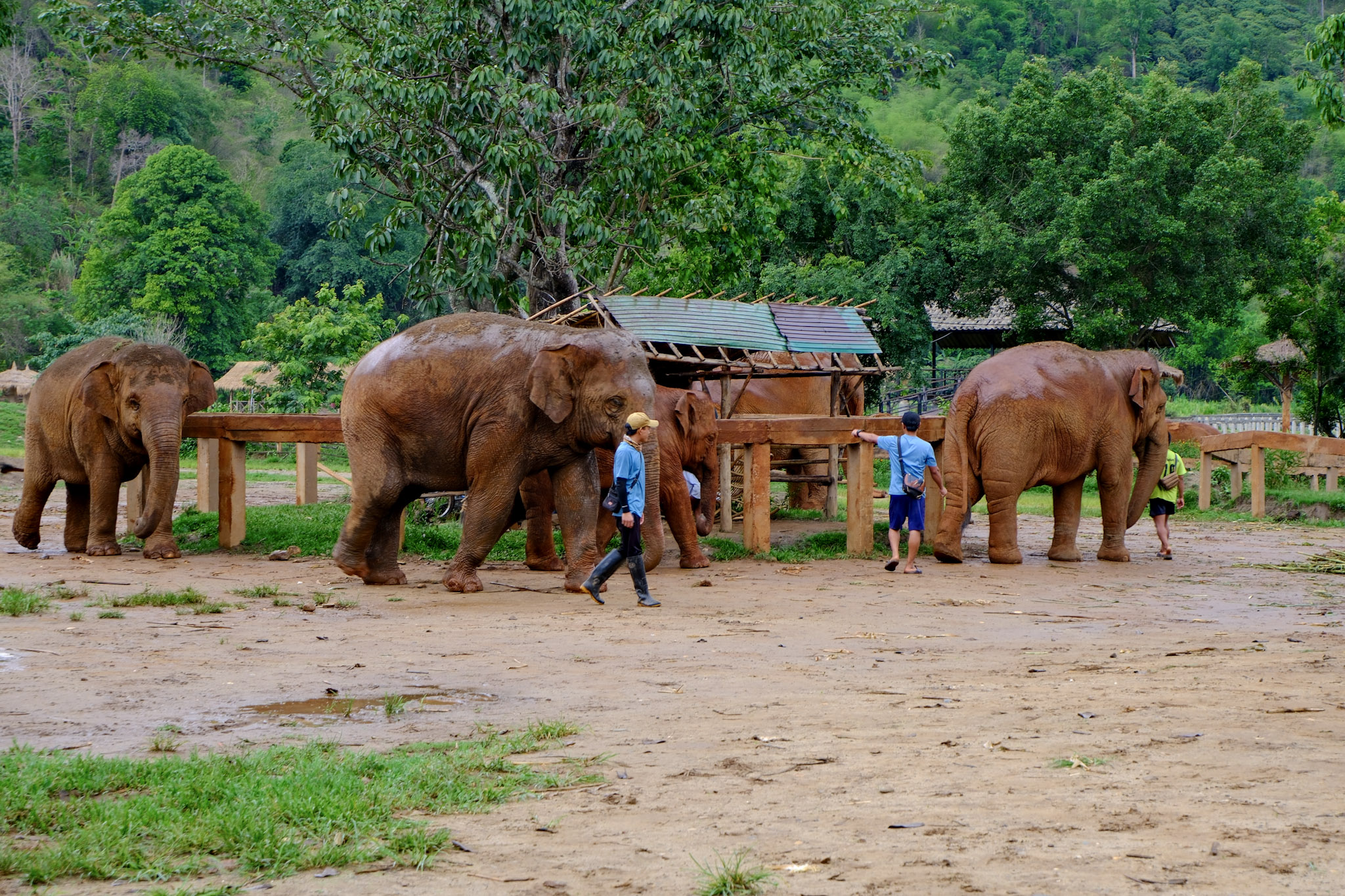
As half-day visitors, we had about 90 minutes to two hours to wander through the section of the park that was home to the female elephants. There was strictly no touching or interfering with the elephants. Instead, we watched and walked slowly and quietly around the park. We had to stay at least ten metres back from the elephants at all times, and if they moved towards us, our guide ushered us back to give them more space.

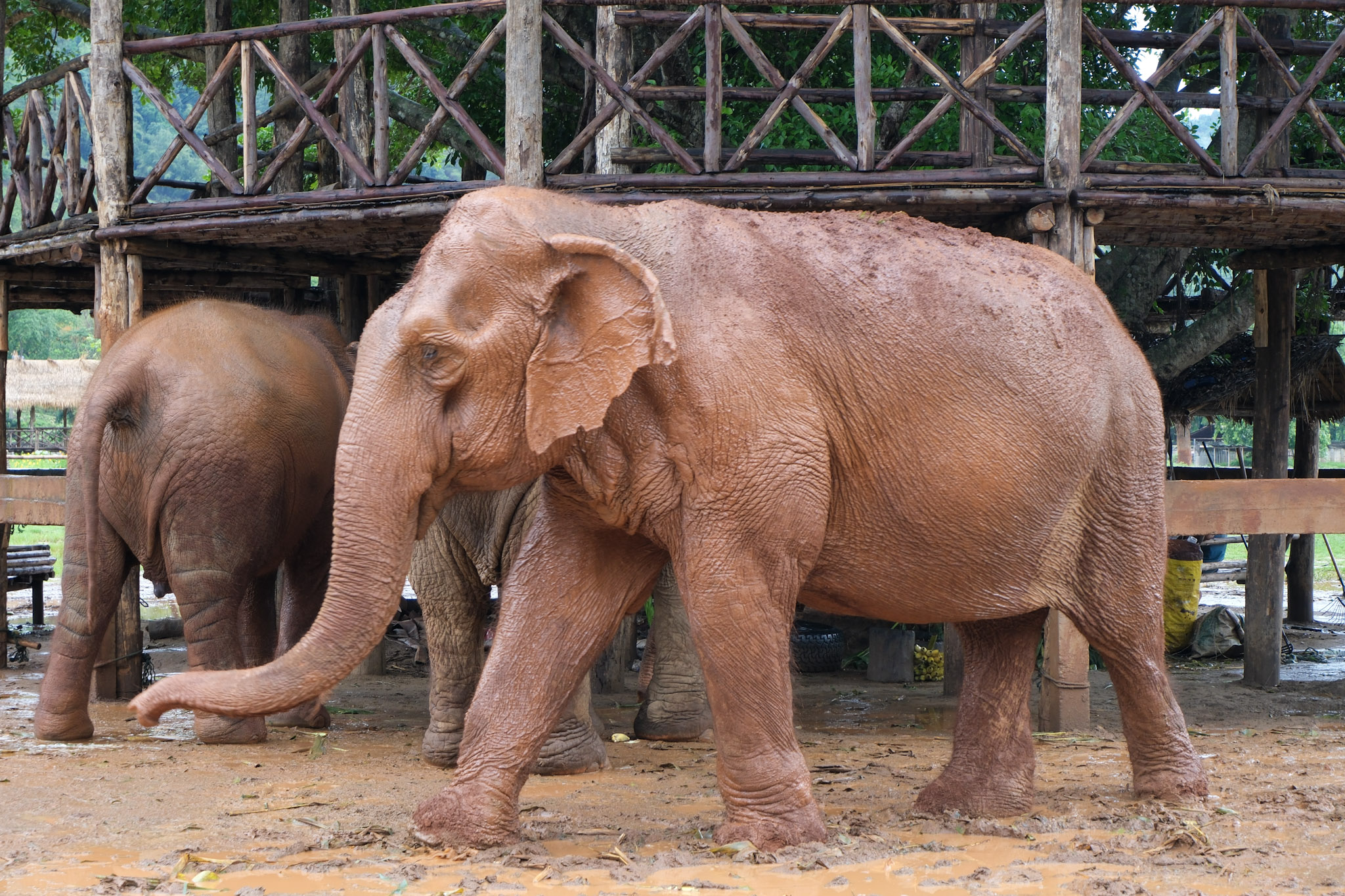
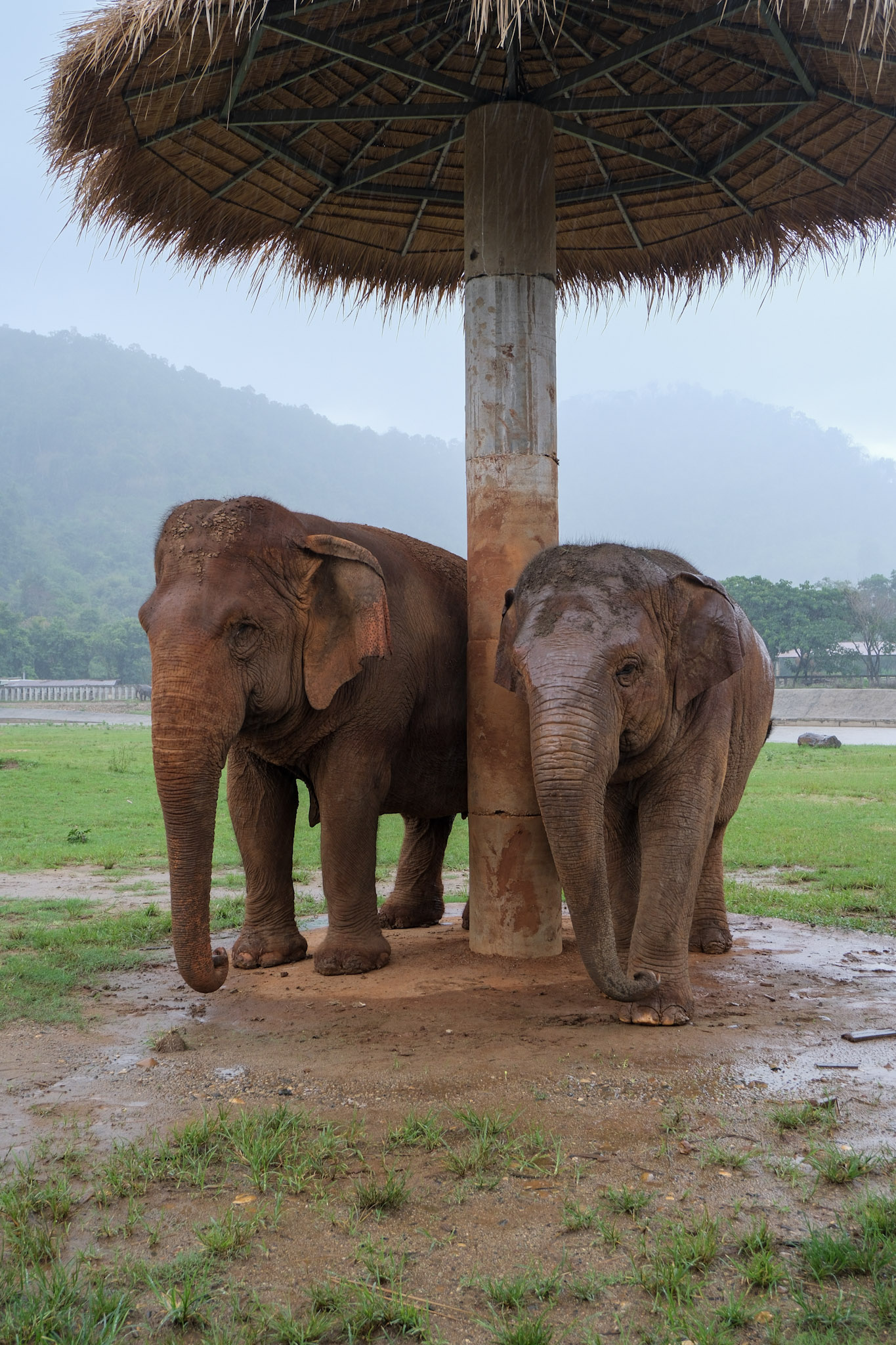
Moving through the park, the guide pointed out various elephants and told us their stories. “This one, she’s the baby,” he said, pointing at the smallest in the herd, “and these two are her mother and her nanny.” He went on to explain that female elephants often form bonds with younger elephants, acting as their nannies and helping look after them. “And this lady, see how she doesn’t place her weight on her front foot?” he said, gesturing to an elephant who was holding one front foot gingerly, “she was injured by a landmine and never fully recovered.”
Each of the elephants at ENP has a story, whether that’s being treated cruelly in the logging industry, or enduring long days standing on concrete in between giving rides to tourists. The guides here know the story of each elephant, and how they came to be at ENP, and the experience at the park seemed to be as much on learning about the individual elephants as appreciating these beautiful animals as a whole.
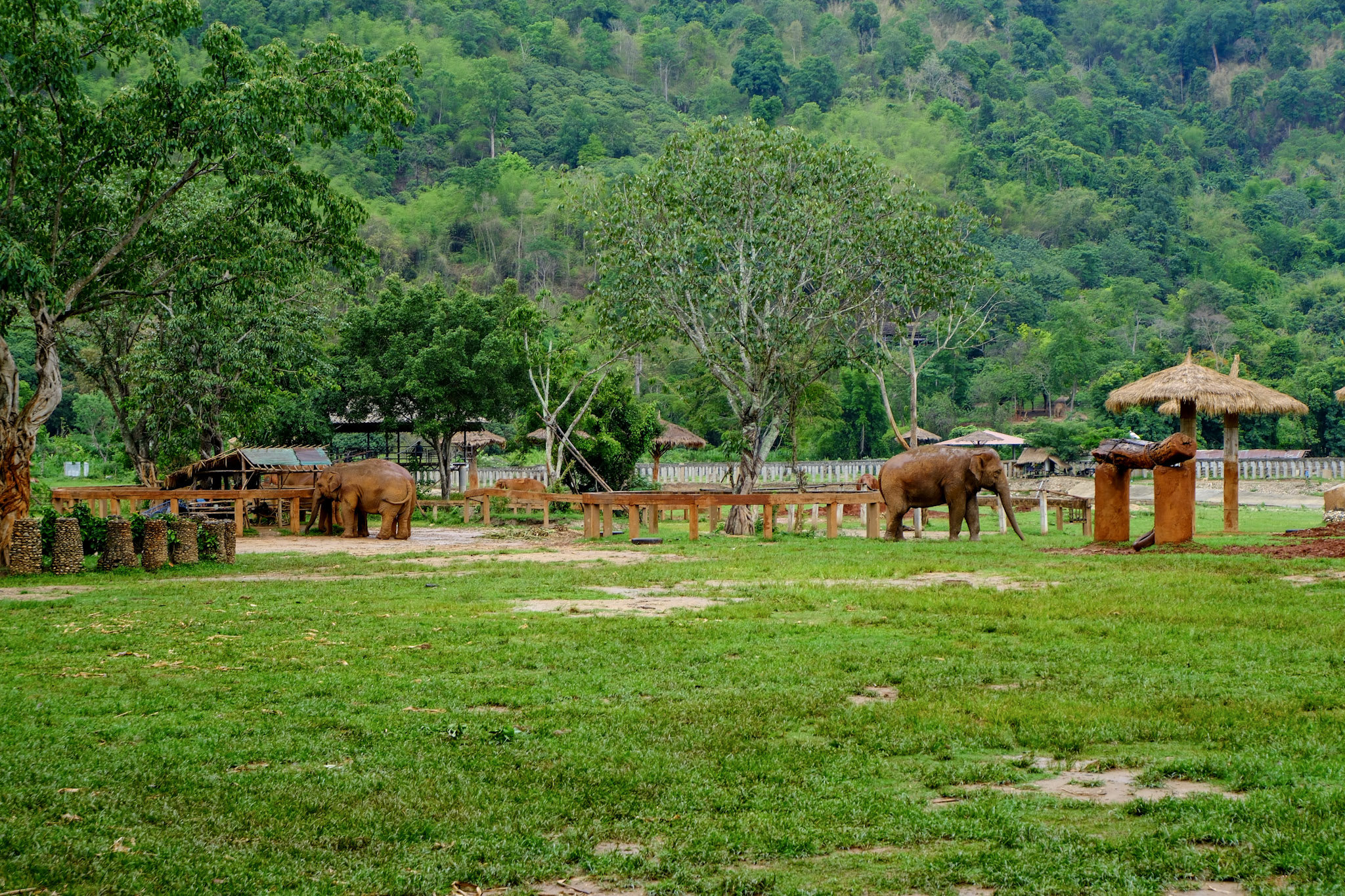
Some elephants wandered slowly through the fields, others stood quietly eating while staff brought them food, and several made their way into the river to bathe. There was no obvious schedule or performance; the elephants simply seemed to move about as they pleased. One of my favourite moments had nothing to do with the people at all, it was watching a brazen dog confidently trot over to greet one of the elephants as if it were the most ordinary thing in the world.
One of the things I had read online was criticism that the park felt overcrowded. This wasn’t my experience at all. We visited in late May, so maybe it was the season, but we only saw one other group than our own, and maybe about 10-15 elephants total, spread out throughout the park. It didn’t feel as though there were hundreds of tourists traipsing through their land, and the elephants weren’t forced over to us for our entertainment.
We also learned more about the rescue methods of the elephants. Some had been voluntarily surrendered when their owners could no longer afford to keep and care for them, others had been temporarily brought to the park to recover after injuries, while others still were purchased from their owners so they could live the rest of their lives out at ENP.

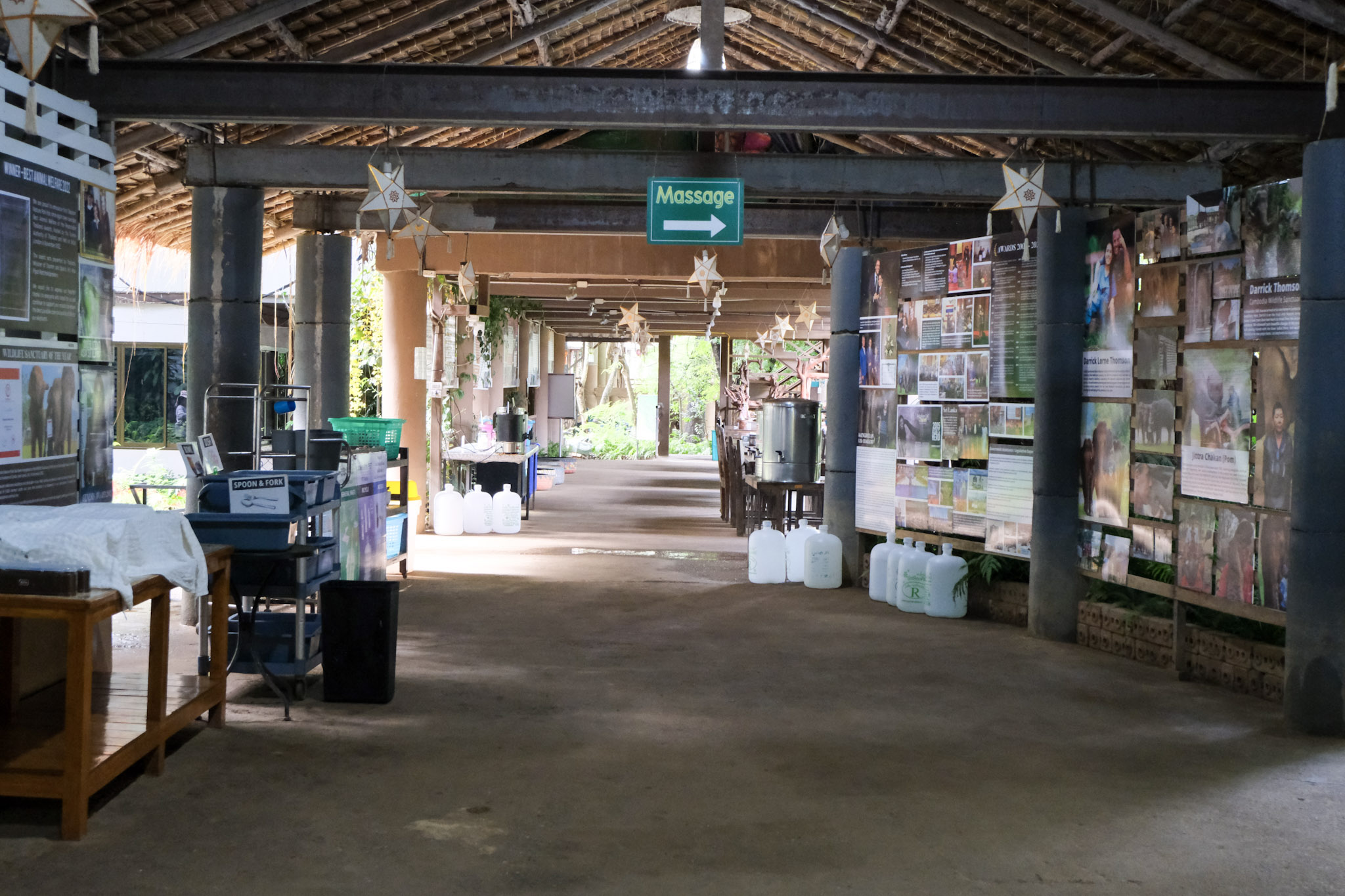
After the experience, we headed back into the visitor centre for lunch. The lunch on offer is a buffet of Thai dishes, all entirely vegan. We were given about an hour to eat and wander around the visitor centre, which is covered in posters and walls telling us more about the story of ENP, Lek Chailert’s mission, and the elephant trade in Thailand.
As we made our way back to the van to begin our return to Chiang Mai, I took one last look at the elephants, still wandering peacefully through the park. While I still felt conflicted on the idea of animals as tourism, I could appreciate that the 2,500 THB we’d each paid went towards preserving this park, the massive amounts of food the elephants eat each day, and keeping the accounts full to pay off more elephant owners in the future.
The Shades of Grey: What Made Me Uncomfortable
Elephants as a Tourist Attraction
As much as I can appreciate that the funds are needed from tourists to keep the work of ENP going, there’s no denying that the park itself is a tourist attraction.
Even though there was no riding, touching or bathing, I was still paying money to watch wild animals. The experience was built around people coming to see elephants, and that inevitably changes the relationship between conservation and tourism.
I was still there for personal reasons
I’m not a vet, I’m not a conservationist, and I wasn’t there as a volunteer to help care for rescued elephants. I was a tourist in Thailand.
Yes, I wanted to support a sanctuary that I believed was trying to put elephant welfare first, and yes, I wanted to learn more about the elephants. Could I have done this without actually going to visit them? Yes, to a degree. This made me question my own motivations.
Tourism funds the solution, but also creates dependency
One of the realities that ENP is very open about is that caring for elephants is expensive. While the land was gifted, its upkeep isn’t free. On top of that, food, veterinary care, staff and other operating costs all cost money.
The income from visitors makes all of this possible, yet it also means the sanctuary depends on tourists continuing to come.
There’s an uncomfortable tension there. Without tourism, many rescued elephants might not receive the care they need. With tourism, elephants inevitably become part of a visitor experience.
Humans created the problem sanctuaries are trying to solve
While an ethical elephant sanctuary is, in theory, a wonderful thing, we can’t deny that they only exist because of human created problems. I saw elephants whose backs were curved due to years of giving rides to tourists, but that problem wouldn’t exist if tourists weren’t paying for it.
On another part of my trip, in Koh Samui, I saw an elephant in a concrete-floored enclosure, with a saddle strapped to their back, waiting on tourists to hop aboard.
My face must have come with subtitles because the guide leaned over and quietly said, “Thank you for not saying anything. This is how they feed their family.”
That sentence has stayed with me.
Sitting comfortably in London, it’s easy for me to say what people should or shouldn’t do. It’s much harder to judge someone whose livelihood depends on tourism in a country where opportunities are different to my own.
This cycle wouldn’t exist without human tourists. Tourists create the demand. Some people exploit elephants to meet that demand. Sanctuaries then spend years trying to rescue those same elephants, funded by… more tourists.
There’s no such thing as a perfect vegan
For those of us who are vegan, we’re often held to ethical account more than others. Is it still okay to buy leather if its second hand? What about eating honey? What about going to a restaurant that serves meat?
I’ve lost count of the amount of times I’ve heard “but if you were on a desert island, would you eat meat then?” I don’t know Bob, I live across the road from a Tesco, so it’s never really come up.
As vegans, should we be visiting ethical animal sanctuaries, or does that cross the line too? I don’t have answers to any of these questions. My guiding principle has always been to reduce harm where I reasonably can. That’s easy to follow when it comes to my grocery shopping, it’s a lot harder when the knock on effects or the bigger picture get murky.
That’s where I landed after visiting Elephant Nature Park. I don’t regret spending so much time researching it before I booked, and I don’t regret continuing to question my decision afterwards. If anything, I’d be more concerned if I’d come away believing I’d found a perfect answer.
I don’t think I did.
I think I found a sanctuary that appears to be doing meaningful work in an imperfect world, and I’m still sitting with the tension of that.
Questions I’d Ask Before Visiting Any Animal Sanctuary
After researching Elephant Nature Park, these are the questions I’d ask before booking any wildlife experience:
- Does the organisation rescue animals or breed them?
- Can visitors touch, ride, or bathe the animals?
- Can the animals behave naturally?
- Is the organisation transparent about where the money goes?
- Does the experience prioritise the animals, even if it means the tourists see less?
- How many tourists do they allow in at one time?
So…Would I Visit Elephant Nature Park Again?
If you’d asked me before I visited whether Elephant Nature Park was ethical, I wanted a simple yes or no.
I don’t have one.
What I do believe is that Elephant Nature Park appears to be genuinely trying to improve the lives of elephants that have already suffered enormously. I also believe that funding that work through tourism creates ethical questions that don’t have easy answers.
Would I visit again?
Honestly, no. That’s not because I regret it. On a selfish, personal level it was an amazing thing to be able to see these animals with my own eyes. On a broader scale, I don’t need more than that and I don’t need to repeat the experience.
Would I recommend it to others?
Also no. Not because I found anything untoward. After everything I researched and experienced, I still believe it was the most responsible choice available to me. But I don’t think it’s my place to tell someone else they should visit. That isn’t the purpose of this post.
If you’ve read any of my other travel guides, you’ll know I don’t hesitate to recommend hotels, restaurants or experiences that I genuinely enjoyed. This feels different.
And, if you’ve gotten this far, that’s probably what you were looking for too. I’m not deliberately trying to be vague in my stance, it’s because I genuinely don’t think there’s one right answer.
If you’re trying to find the ideal ethical elephant sanctuary, there’s no neat, binary yes/no list I can give you. What I can give you is my experience, my findings, and Responsible Travel’s list of the sanctuaries they support.
The rest is up to you to decide where you align.