
Uzbekistan as a Vegan: What’s it Really Like?
Let me start off by saying: I was an idiot when I visited Uzbekistan. I did minimal planning and took the very Irish approach of “it’ll be grand” to exploring Uzbekistan as a vegan. It was not grand. It was how I ended up in my hotel room in Samarkand, my fingers poking into the corners of an empty pistachio bag for any wayward green nuts while warm beer coursed through my empty stomach.
I’d gone to Uzbekistan as part of a group tour, and naively assumed that when they told me they could handle vegan accommodations, that was me sorted. And look, I didn’t starve. I had some absolutely amazing dumplings, breads, and vegetables during my time there… but my trip would have been a lot more enjoyable if I’d done a bit more pre-planning and less time tapping “how to say vegan in Uzbek” into my phone.
You, however, are clearly a lot wiser than I am because you’ve ended up here. Ten plant-based points to you. If you’re planning your own trip to Uzbekistan as a vegan, then firstly: excellent choice. It’s still one of the most breathtaking countries I’ve ever had the privilege to visit. And secondly, I’ve got you covered.
I’ll talk you through the great plant based finds I came across, the “accidentally vegan” foods you’ll see everywhere, and tips to make your own trip to Uzbekistan as a vegan a lot smoother.
The Reality Check: What is it really like?
You know that scene in My Big Fat Greek Wedding where Toula tells her mom that Ian is a vegetarian, and after a pause, her mom replies “That’s okay, I’ll make lamb”? Well, Uzbekistan as a vegan isn’t too far off.
Veganism isn’t something that’s common at all in Uzbekistan, especially if you’re coming from somewhere like London where it’s common to see a little “VE” on a menu, even if the options aren’t always mind-blowing.
Uzbekistan was historically a nomadic, agrarian culture so the cuisine that developed over time relied on high-calorie, locally available ingredients to keep energy up for heavy manual labour. The national dish is plov, a dish made with long grain rice, carrots, spices and usually chunks of mutton. It’s common for animal fat (especially from lamb tail) to be used for flavour, even in otherwise vegetable-forward recipes, and as my pistachio-and-beer dinner goes to show, a vegan adaptation is not something you can take for granted.
As tourism in Uzbekistan rises, vegan and vegetarian accommodations are too, but it’s still not a commonly understood diet. You’re going to have better luck in the main tourist cities, and if you’re planning on any tours that take you out to rural areas, you’re going to need to plan ahead and take your own backups.
On the bright side, the bread and the produce in Uzbekistan is outstanding. Uzbekistan is actually Russia’s biggest supplier of tomatoes, and they’re known as the world capital of melon production. Seriously, I even stumbled across an entire multi-day melon festival while I was in Khiva, that’s how big a deal it is.
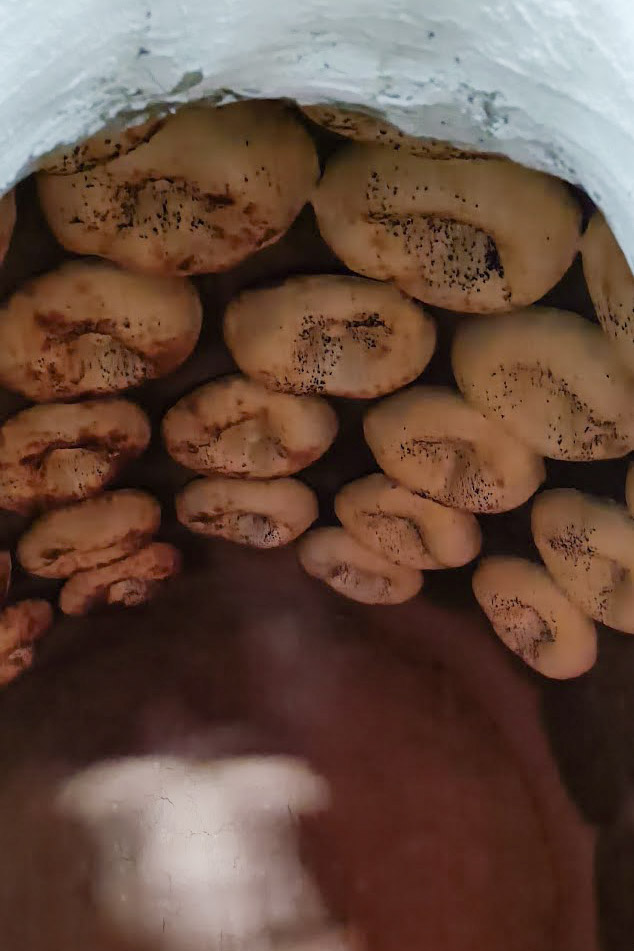
You’ll also find incredible bread, called non, which is a traditional flatbread baked in clay tandir ovens and decorated with beautiful patterns.
My Experience of Uzbekistan as a Vegan
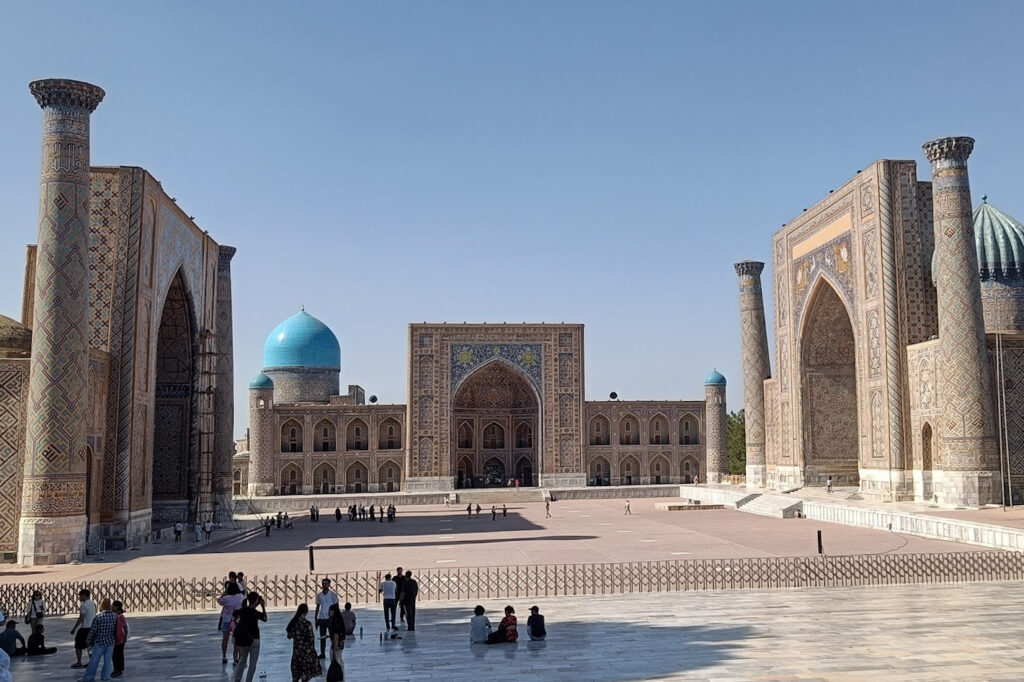
When I went to Uzbekistan for two weeks in the summer, part of that was on a group tour. I’d asked ahead of time if they could accommodate vegans, and I was told that while there may be some things I can’t eat, generally yes they could handle it. The tour also had the advantage of having an Uzbek guide, Jonibek, who was a real help with navigating menus and speaking to restaurant staff about accommodations.
Even with this advantage, it’s still not for the weak. In reality, hotel breakfasts were poor on protein. Most days, my options were dry cereal, toast, fruit, and jams. In restaurants, it was bread, salad, fries, or pumpkin manti dumplings. In short, a very carb-heavy diet, very low on protein, and made me feel quite bloated and sluggish in the August heat.
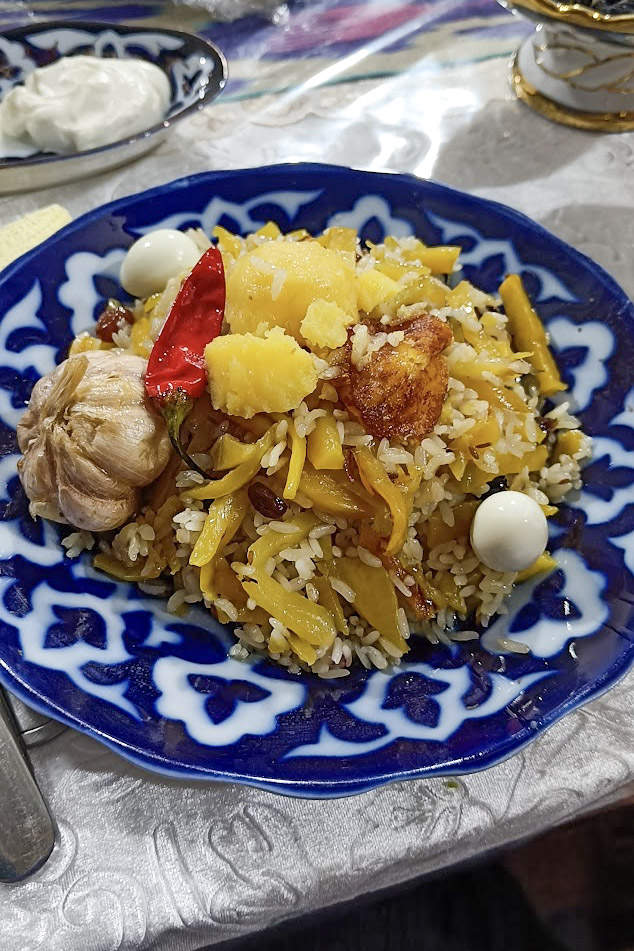
As part of the tour, we also went to a local family’s home for a plov demonstration and dinner. Jonibek had spoken to them ahead of time, and they’d made a separate, fully vegan plov with chickpeas instead of lamb, just for me.
It did get slightly lost in translation as two hard-boiled quail eggs were also placed at the side of my dish. I was okay discreetly picking them off, but the rest of the meal was fully vegan.
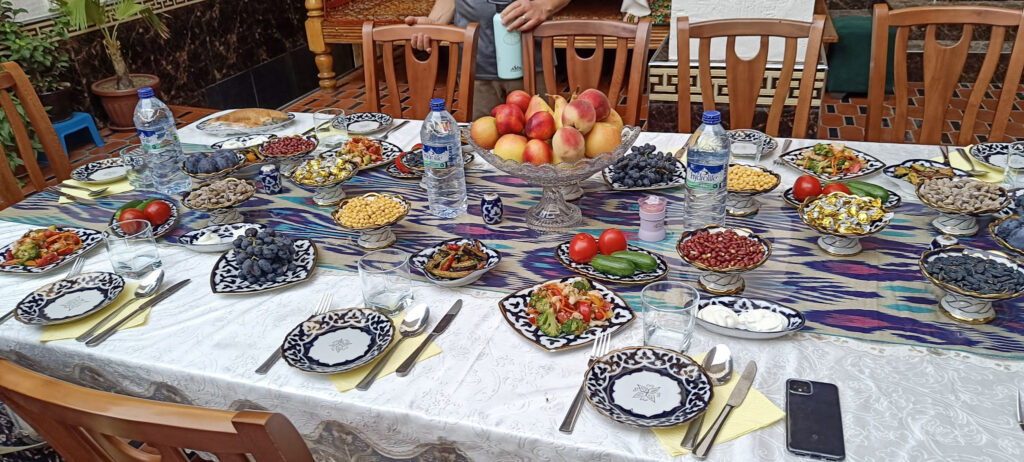
This particular family were wonderfully warm people, and incredible hosts, and I was really touched by the effort they’d gone to. In Uzbek culture, it’s standard for a family to have a range of sweets, jams, fruits, and nuts arranged on the table for guests to help themselves to, and they’d included plenty that I could eat too.
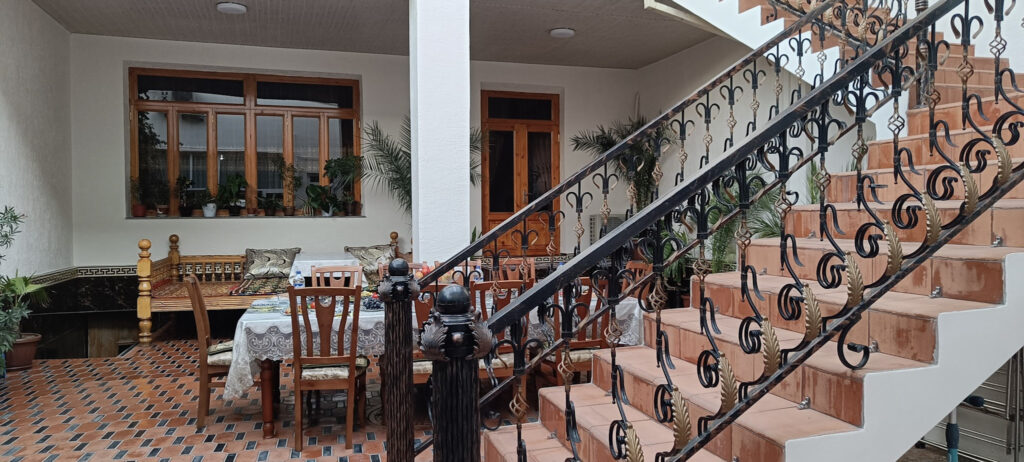
That night, I ate like a queen in the courtyard of this lovely family home, sitting at a table laden down with the traditional blue and white pottery and displays of sweets.
On the flip side, there was a night we went to a dinner show with traditional dancers in the wide open courtyard of a Bukhara madrassa. While everyone else had a multi-course meal, I had a lentil soup. Even though Jonibek had gotten in touch with them ahead of time, they said they couldn’t do anything to accommodate vegans. By the time the dancers took their final bows, the other restaurants in the city were closed and I went to bed still hungry, and cranky.
There were also times that I chose to skip group dinners, preferring instead to check Happy Cow to grab a bite somewhere else. In Tashkent, this was pretty easy as I’d come across EcoCafe, Uzbekistan’s first vegetarian restaurant. In the three days I spent in Tashkent, I ate there three times.
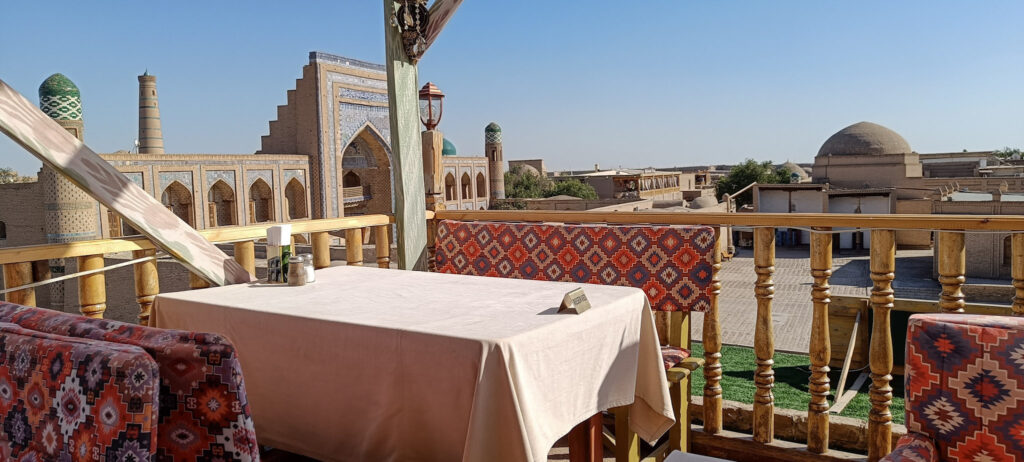
In Khiva, my repeat visits were to the Terrassa Cafe & Restaurant which had incredible views out over the old city, as well as some genuinely delicious potato dumplings. Normally, the dumplings come as a mixed variety. As I was ordering, the waiter raised an eyebrow, “Only potato?”. Not to live up to the Irish stereotype or anything, but yes, please give me the spuds.
The Uzbek people are some of the warmest, most hospitable people I’ve met. The reality is though, that it’s not a place that’s had a large demand for vegan options, so they simply don’t always exist. When they do, they tend to be a variation of heavy carbs and salad. While both are delicious, they don’t feel great after two weeks of the same diet.
Had I planned my Uzbek trip better, I would have had a significantly better time. When I went to Kyrgyzstan and Kazakhstan, I’d learned my lesson and stocked up on Huel as an emergency meal backup. Even though Kyrgyzstan is far less likely to accommodate vegans, my experience was infinitely improved by balancing my nutrition.
Navigating the Language Barrier
In Uzbekistan, the word “vegan” isn’t a common word, and sometimes even “vegetarian” will still mean you get a chicken salad.
To make sure you’re getting fed without having a plate of lamb arrive to your table, you’ll need to be able to translate a few phrases, or have a translation app handy.
What Languages Do They Speak in Uzbekistan?
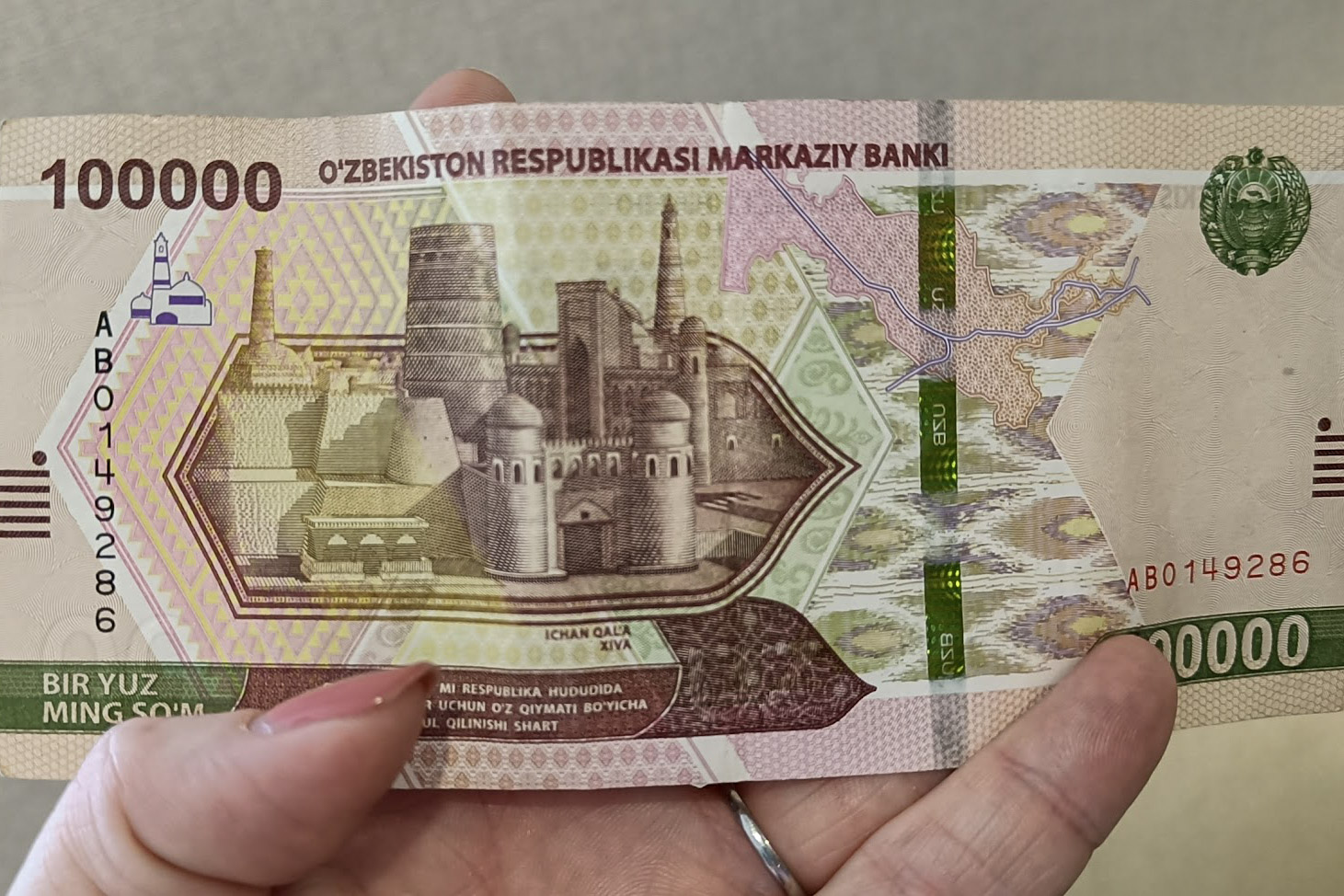
Uzbekistan and Ireland are similar in that both countries have their own language, and one left behind by an occupying power. The difference, however, is that the Uzbeks actually speak their own language, while the best Irish (never “Gaelic”) I’ve got to offer is asking to use the bathroom (fellow Irish people will be mentally reciting ‘An bhfuil cead agam dul go dtí an leithreas’ right now).
While Uzbek is the official language of Uzbekistan, most citizens are native speakers in Russian as well. It’s the de facto second language of the country, and the most commonly used one in public life. It’s common to see street signs in both Russian and Uzbek, and it’s the business language normally used when working with their neighbouring countries of Central Asia.
English is less common, especially in more rural areas. In bigger cities like Tashkent or Samarkand, or in tourist attractions and hotels, you’ll find plenty of people who speak English. Outside of that, it’s not always a given, so I strongly recommend buying an e-sim before you travel so you’ve always got access to a translation app.
Being in Uzbekistan as a vegan, being able to translate your dietary needs into Uzbek or Russian is going to be the best chance you have at getting a good meal. As for which language, that’s up to you. Personally, I find Russian a lot easier.
I’ve been with my Bulgarian husband for 13 years, so in that time, I’ve picked up some Bulgarian and can read the Cyrillic alphabet. It may look daunting at first, but it’s actually a fairly phonetic alphabet – words are much more consistent than English, you won’t find ‘gotchas’ in the way English has with words like ‘yacht’ or ‘epitome’.
Key Phrases for Vegans in Uzbekistan
Uzbek Phrases
| English | Uzbek | Phonetic |
| I am vegan | Men veganman | Men ve-gan-man |
| I am vegetarian | Men vegeterianman | Men ve-ge-te-ri-an-man |
| I don’t eat meat | Go’sht yemayman | Gosht ye-may-man |
| Without meat | Go’shtsiz | Gosht-siz |
| No animal fat | Havyon yog’isiz | Hay-von yo-ghi-siz |
| No milk or eggs | Sut va tuxumsiz | Soot va too-khoom-siz |
| Thank you | Rahmat | Rakh-mat (the ‘h’ in rahmat is pronounced more like the ‘ch’ in a Scottish loch) |
Russian Phrases
Russian is a gendered language, so some phrases will have male/female variants, denoted by ‘F’ or ‘M’ in the table below.
| English | Russian (Cyrillic) | Phonetic |
| I am vegan | F: Я веганка M: Я веган | F: Ya ve-gan-ka M: ya ve-gan |
| I am vegetarian | F: Я вегетарианка M: Я вегетарианец | F: Ya ve-ge-ta-ri-anka M: Ya ve-ge-ta-ri-a-nyets |
| I don’t eat meat | Я не ем мясо | Ya nye yem m-yasa |
| Without meat | Без мяса | Bez m-yasa |
| No animal fat | Без животного жира | Bez zhi-vot-no-va zhi-ra |
| No milk or eggs | Без молока и яиц | Bez mo-lo-ka ee ya-eets |
| Thank you | Спасибо | Spa-see-ba |
“Accidentally Vegan” Uzbek Classics
Non: Uzbekistan’s Traditional Bread
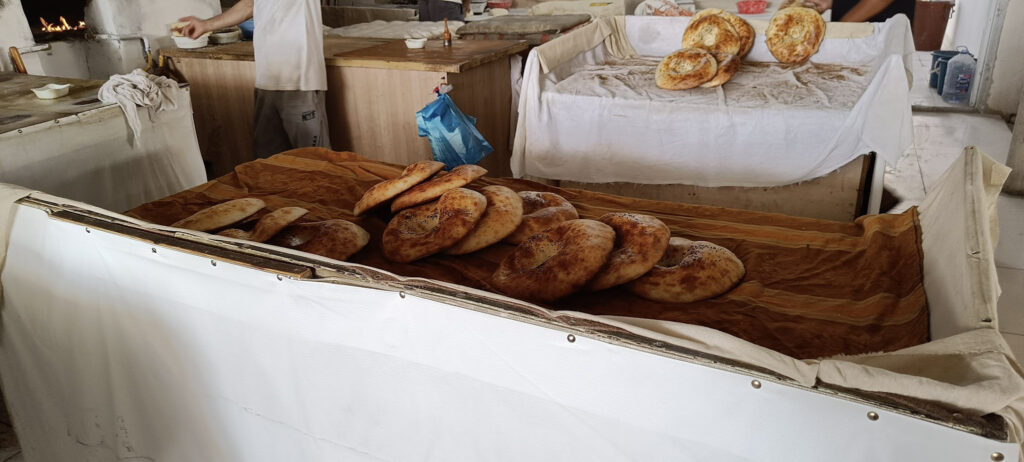
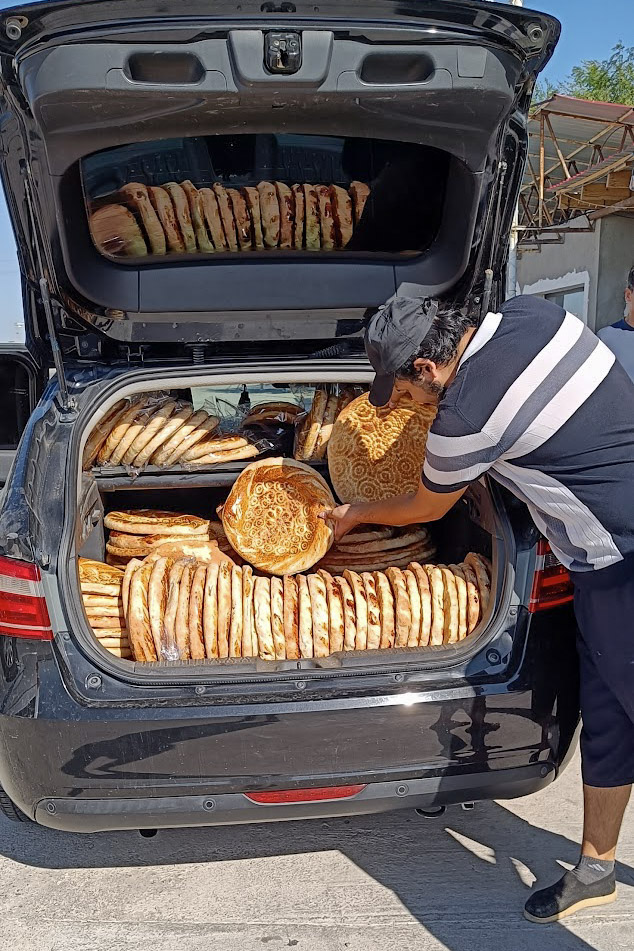
In Uzbekistan, bread is a sacred cultural tradition. You’ll see it everywhere, from street stalls to fancy restaurants, and even being sold out of the boot of a car as I saw on my travels. It’s round, usually stamped with fancy patterns, and cooked in a traditional tandir clay oven.
The bread is usually broken by hand, rarely with a knife, and it’s seen as disrespectful to place it face-down on the table.
There’s two main types: Obi-non and patir/patyr. Obi-non is the one you’ll see everywhere. It’s made from flour, water, salt, and yeast and is almost always vegan.
Patir however is the one to avoid. This is the heavier, flakier version that you may see at bazaars. It’s made with milk, butter, or sometimes mutton fat. If you’re not sure what you’re looking at, ask if it’s patir – if it is, it’s not for you.
Achichuk and Salads
If you’re from the UK or Ireland, a tomato is a sad, watery thing you get on a burger. In Uzbekistan, you’ll remember what a tomato is actually supposed to taste like.
Achichuk is a staple salad of Uzbekistan, and you’ll find it pretty much any traditional restaurant. It’s a simple salad of razor thin tomatoes, onions, and sometimes chilli or basil. Usually without a dressing, just some oil, salt and pepper.
I know, I know, it’s such a vegan cliche to say “just have bread and salad!”, but look if you’re not exactly spoiled for choice, the salads in Uzbekistan are fresh and delicious.
Outside of Achichuk, you’ll find simple salads like cabbage and carrot, or cucumber, tomato and pepper. Do make sure to check (or translate) the menu – it’s common for meat or cheese to feature in salads.
Dumplings: Manti and Somsa
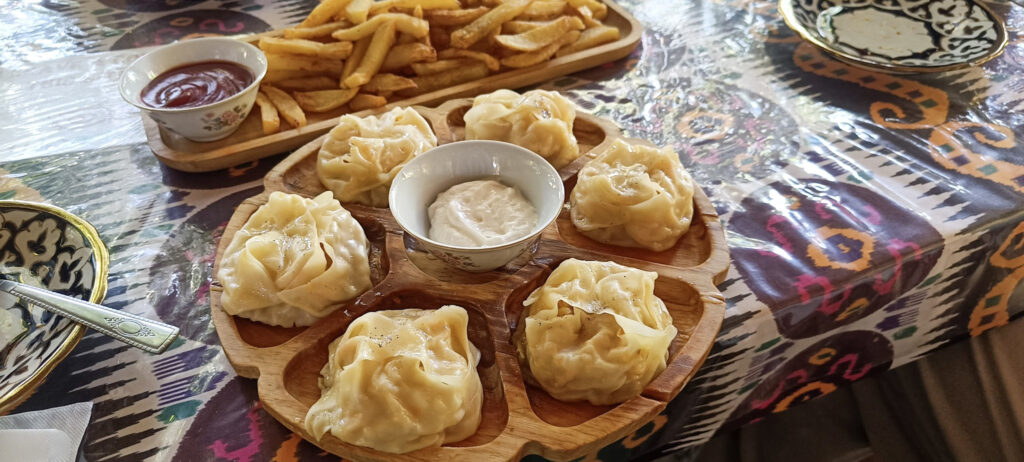
Almost everywhere in Uzbekistan, you’ll see manti and somsa on offer on the menu.
Manti are large, steamed dumplings, while somsa are baked pastries (similar to a samosa, but usually flaky or with thick pastry).
Both are staples of Uzbek street food and both come in a pumpkin (kadu) variety that should be vegan. But, like with anything, you’ll need to double check.
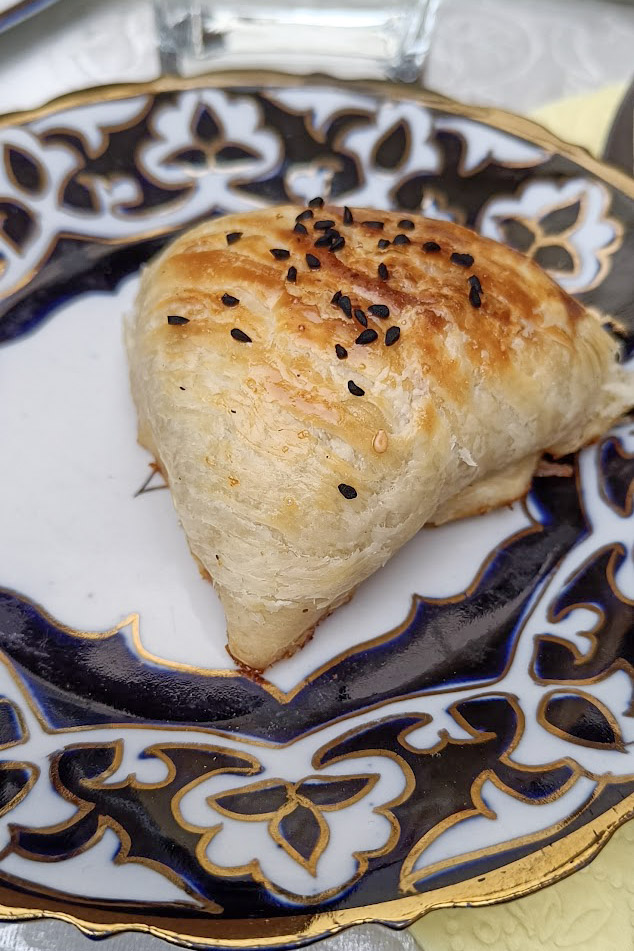
Most of the time, the filling is pumpkin and onion. Some traditional cooks will still add small cubes of lamb tail fat (dumba) to the pumpkin. Likewise, some somsa are brushed with egg or butter before being put in the oven to help them get a golden finish. This is where that “without animal fat” phase is going to come in handy – “Hayvon yog’isiz?”
Manti are almost always served with a side of sour cream. Thankfully, this usually comes in a little dish, but you can double check and ask for it without.
Manti were my best friend in Uzbekistan. They’re made from a thin, light dough so they’re not as heavy as somsa, and they’re surprisingly filling. I even saw courgette and mixed veg varieties on some menus.
Kartoshka Barak: Khiva’s Potato Dumplings
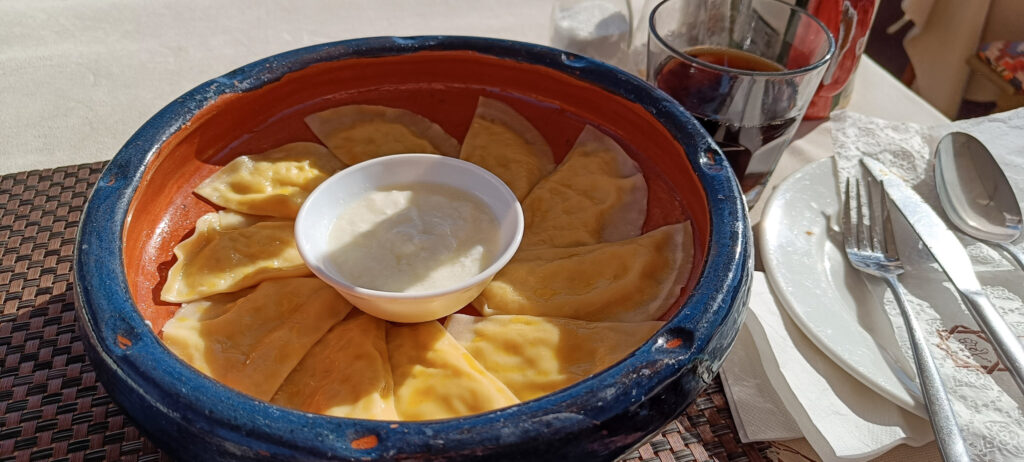
If you find yourself in Khiva, look for this regional speciality: Kartoshka Barak. The city is famous for tuxum barak, egg filled dumplings, but you can often find a version filled with smooth, seasoned mashed potatoes.
Their thin dough is similar to manti, but rather than being a round, pleated shape, they’re flat and shaped like half moons – very similar to Italian mezzelune or Polish pierogi.
I cannot tell you how delicious they are. When I was in Khiva, the Terrassa cafe saw a lot of me (even twice in one day), because they were one thing I could guarantee were filling, vegan, and delicious.
They’re often tossed in a little oil or butter after boiling to stop them sticking. Do make sure you ask for them without butter to ensure they stay plant-based.
Stocking up on Snacks
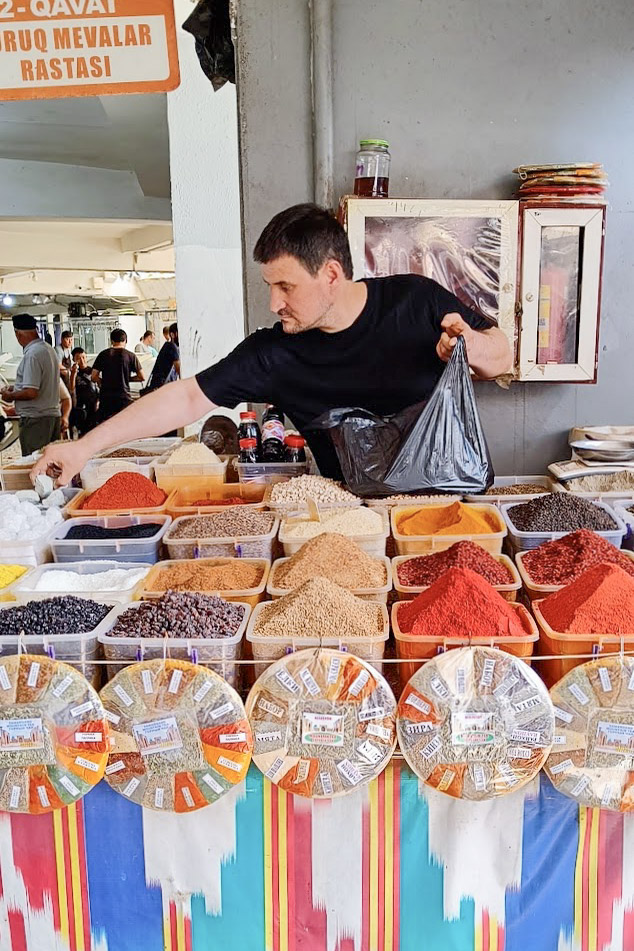
Travelling through Uzbekistan as a vegan means you’re going to need to do a little bit more planning for your snacks. You can’t just stop at the side of the road or rely on food sold in train stations, and as delicious as non bread is, you’ll reach a point where you just don’t want to look at another loaf.
If I was to do it all over again, I’d plan my bazaar trip to properly stock up on snacks, and I’d do some more planning before I even left London.
Visiting the Bazaar
The Nut & Fruit Stalls
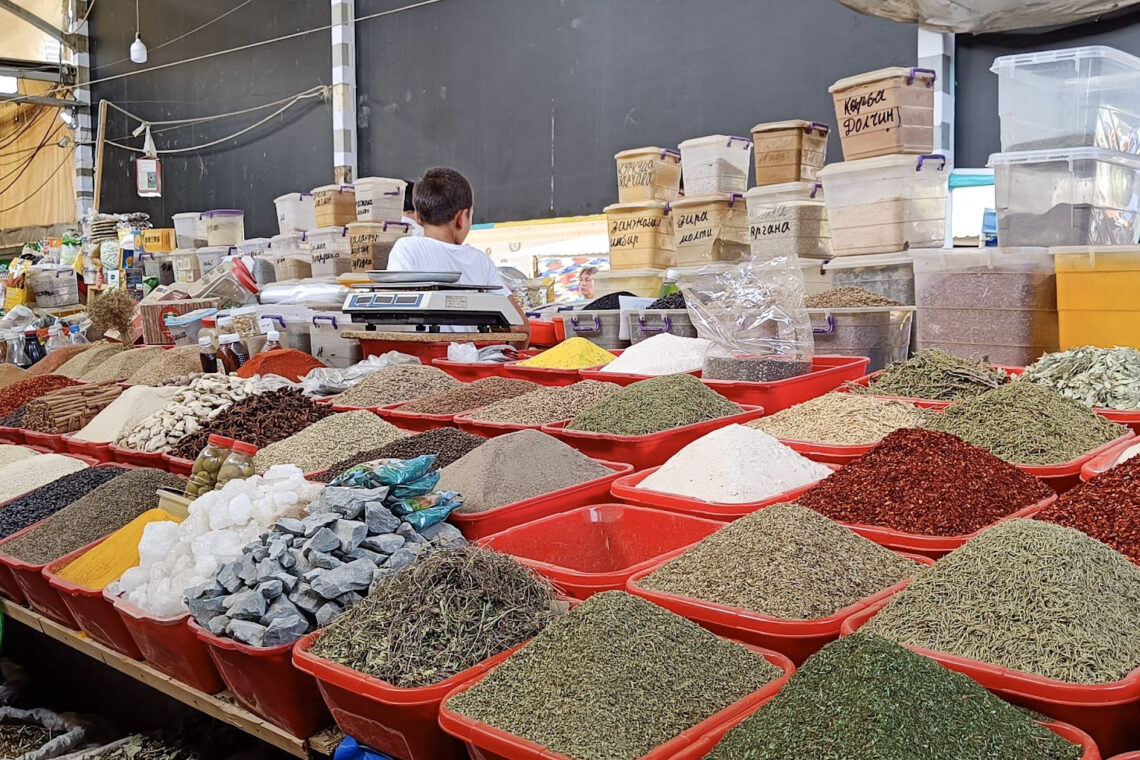
This is your protein station. Uzbek bazaars always have stalls heaped with dried fruits and nuts – the same ones you’ll see adorning a traditional Uzbek table.
Stock up on pistachios, almonds, and walnuts. They’ll last, they’re easy to transport, and they’re a great source of protein.
As for fruits, look for the long, dark raisins. They’re usually sun-dried without oil and are a nice dash of sweetness to your nut mix.
Haggling in the Bazaar
In the bazaar, it’s totally normal, and expected, to haggle on the price. As you walk around the bazaar, stall holders will call out to you, asking you where you’re from, and what you’re looking for. You don’t have to visit their stall, you can smile and keep going. Likewise, don’t feel like you need to buy something just because you had a look.
Pre-Trip Planning & My Secret Weapon
Okay, so this is the biggest thing I would do differently if (hopefully when) I go back to Uzbekistan: stocking up before I leave.
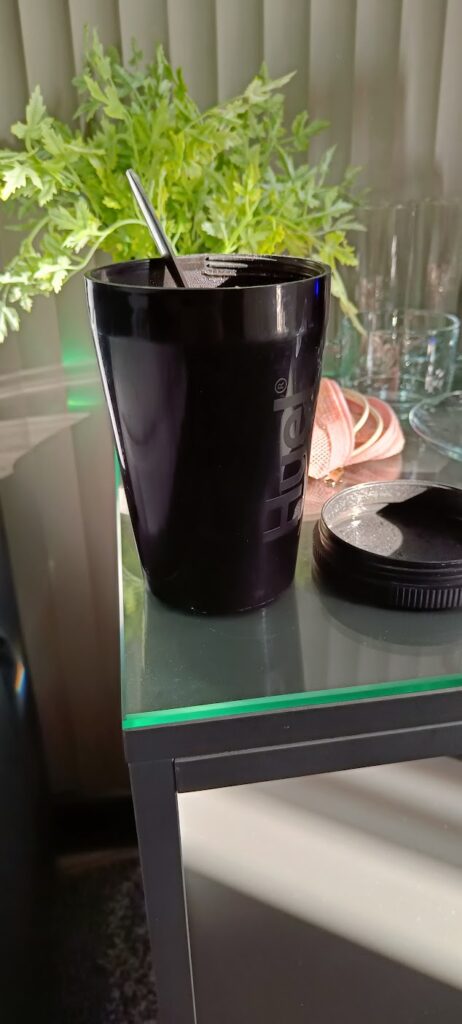
I mentioned it earlier, but honestly: Huel. Specifically, their “Hot and Savoury Meal Packs“. These are all fully vegan, and each pouch has around 400 calories and about 22g of protein. The pouches are dried foods like pasta dishes or noodles, so even if they spend your entire trip shoved at the bottom of your backpack, they’re not going to go bad.
When I went to Kyrgyzstan, I brought one pouch for each day I was there. I didn’t end up using them every day, but the times I did, I was so glad I’d brought them. If you’ve had a full day of nothing but bread and salad, knowing that you can whip up a quick nutritious meal is honestly a game changer.
You need hot water and one of the Huel cups to make them, and it’s not always a guarantee that you’ll have a kettle in your room, especially if you’re doing homestays or spending the night on a sleeper train. I have a battered old Chilly’s bottle I’ve been using for years. It keeps water hot for hours, so if you know you might need to dip into your Huel stash later, ask a cafe or restaurant to fill up your bottle with boiling water.
When I was flying to Bishkek, Kyrgyzstan, I was flying with an airline that didn’t provide inflight meals. I asked Pret in Stansted to fill up my water bottle with hot water and made my own Huel on the flight.
It’s not the most gourmet food out there, and I know you’re probably thinking “why would I travel to another country just to eat some Huel?”, but trust me on this one: It’s better to have it and never need it, than end up cranky and hungry and wish you’d brought some.
I’ve also written a more general vegan travel handbook, with the tactics I use to stay fed when I travel. You can get yours by entering your email address below.
The City Guides: Where to Get a Bite
Tashkent
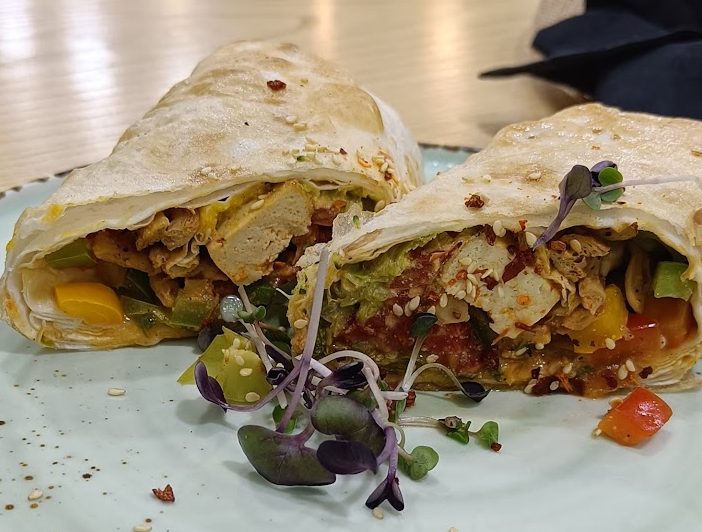
In Tashkent, you’ll find Uzbekistan’s first vegetarian restaurant – EcoCafe. This is a really cute, welcoming place with a huge variety of vegan options, including a weekly plov special. If you’re a vegan travelling to Tashkent, bookmark this one now.
There’s also a vegan food tour in Tashkent, where you can check out vegan street food with a local guide. If you’re travelling with a group, it’s cheaper than just paying for one, but even at the single price, it’s worth getting a local’s insight into Uzbekistan as a vegan.
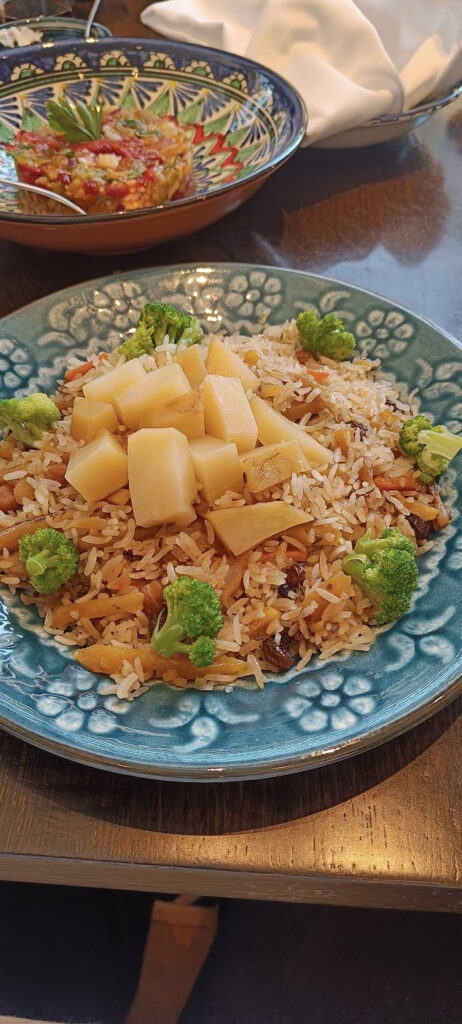
Outside of these options, the Khiva restaurant inside the Hyatt Regency hotel does a vegan plov. I went here my first morning in Tashkent and it was a great introduction to the country’s national dish. You don’t have to be a guest to visit the restaurant.
Samarkand
In Samarkand, there are a few places listed on Happy Cow.
When I was here, I went to the Bibikhanum Teahouse and had some great pumpkin manti in a very traditional, open air setting. It’s also very close to the Bibi-Khanym Mosque, which you’ll likely want to visit, as well as walking distance from the bazaar if your snack stash is running low.
Bukhara
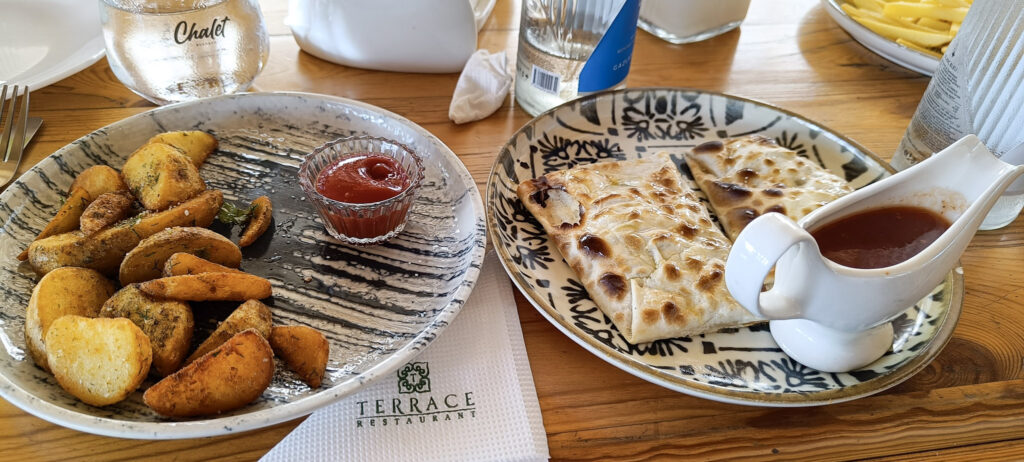
In Bukhara, my best find was the Terrace Restaurant. Their vegan options are very clearly marked on the menu, no guessing here, and they’ve got a lot of them. I had the vegan olot samsa, which are a Bukhara speciality. Instead of the more triangle shaped thick pastry of traditional somsa, the filling is folded up in a lighter, flakier bread and then baked in the tandir.
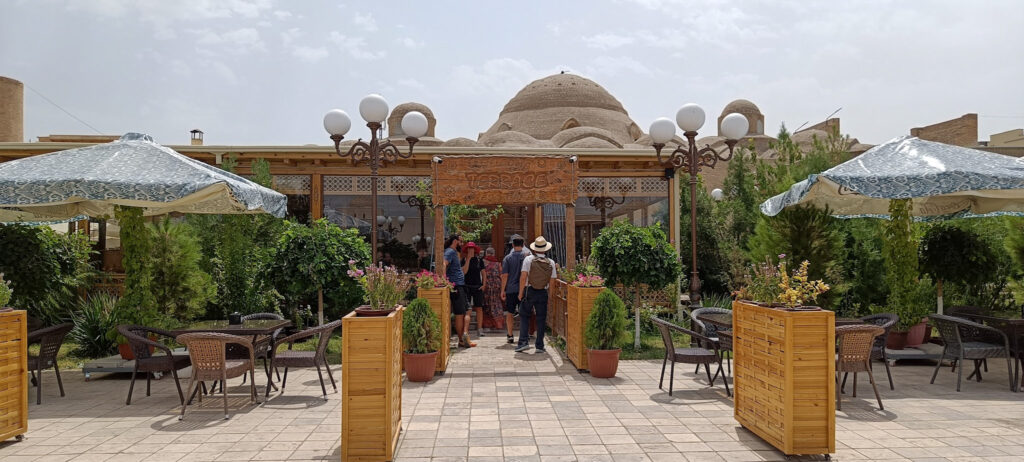
In Terrace, you’ll also find our old pals vegan manti, as well as the opportunity to try vegan lagman noodles.
Do read the menu carefully here – you’ll see some things marked as vegan, but the ingredients may list mozzarella. I don’t know if they use a plant based alternative, but I chose to stick to the more clearly vegan options.
Khiva
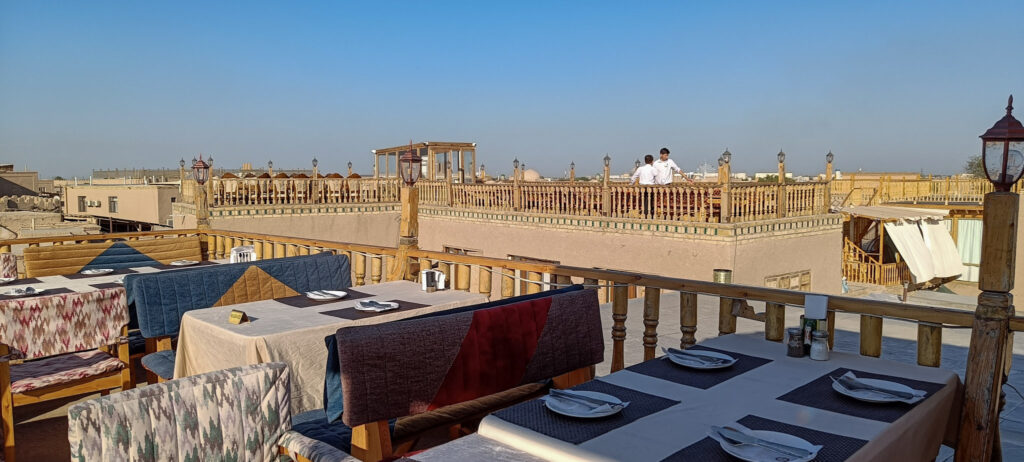
Khiva is where I found my favourite restaurant of my trip: Terrassa Cafe (no relation to Bukhara’s Terrace restaurant).
This place is gorgeous. Try get a seat on the roof terrace if you can, you’ll feel like you’ve stepped right into Aladdin. From there, you’ll have a view out over the old city walls of Khiva and the Kaltaminor minaret. Even if the food wasn’t great (which it is), the view alone is worth a visit.
Naturally, because it’s such a popular restaurant with tourists, the prices are higher than you’ll see in other parts of Uzbekistan.
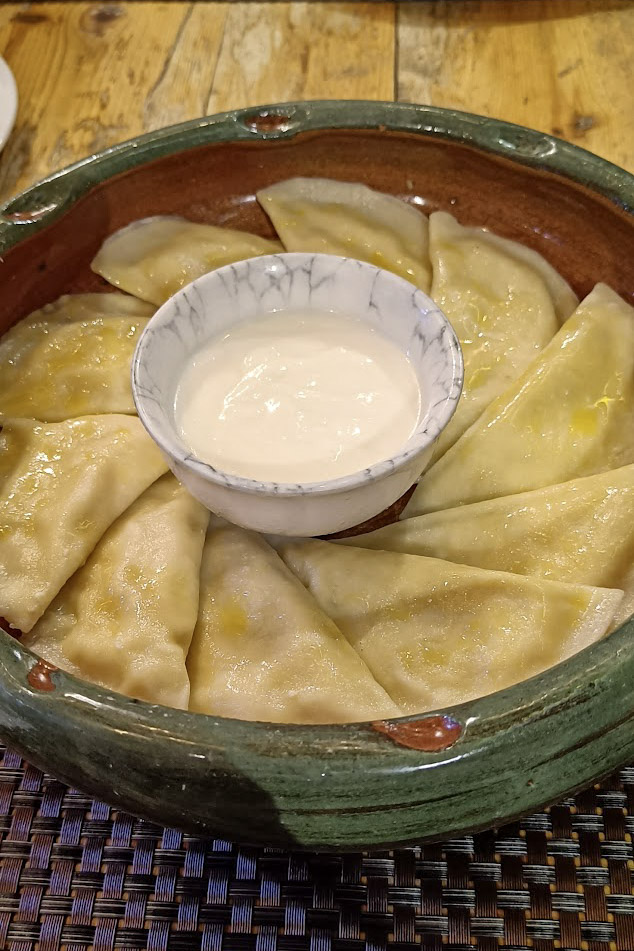
This is where I found my beloved potato dumplings, kartoshka barak. On the menu, you may see it listed as “mixed dumplings” where they serve a variety of dumplings. I asked them if I could have only potato, or on one visit, half potato, half pumpkin. Again, ask them to keep the sour cream on the side, and no butter please.
They’re also got other veggie options on the menu, including Khiva’s traditional shivit oshi (green dill noodles) or vegetable kebabs.
Even just writing this is making me wistful for those dumplings and that view. If you’re in Khiva, please go, you’ll be so glad you did.
Final Tips for Navigating Uzbekistan as a Vegan
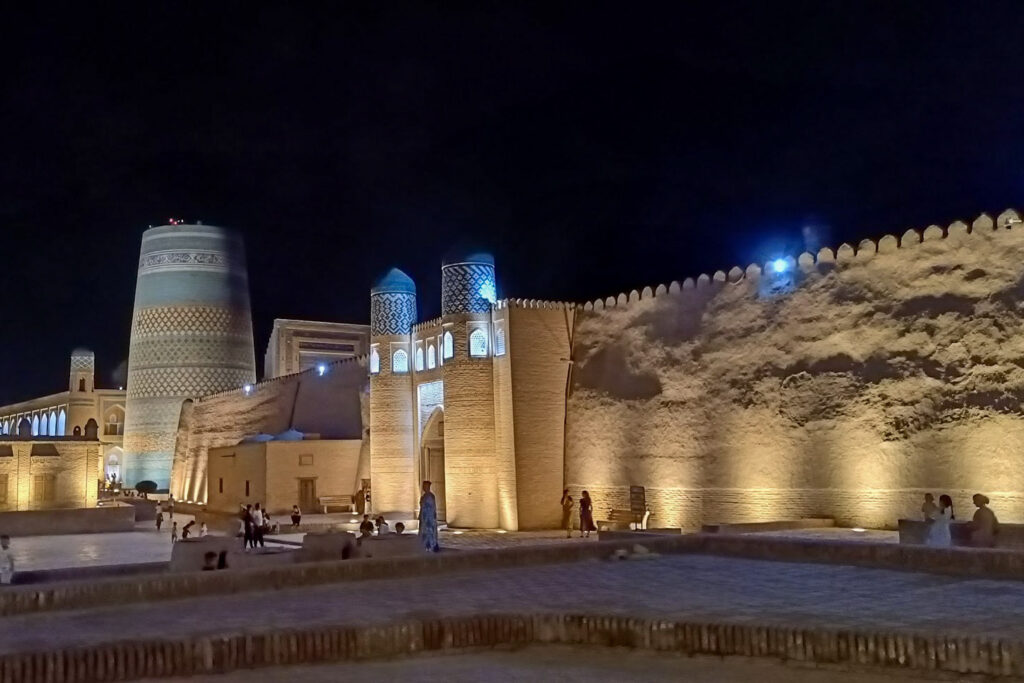
While Uzbekistan as a vegan traveller is not the most obvious choice or the easiest choice in the world, it is incredibly rewarding. Even as I was writing this post, I must have checked Skyscanner about three times for flights from London to Tashkent.
Uzbekistan is a place for travellers who are open to being challenged, but if you embrace that challenge, you’re rewarded with one of the most beautiful countries on earth. And it’s not just that striking blue mosaic architecture, it’s the people, the history, the landscapes, and the customs that make it what it is. It’s somewhere you’ll need to check for lamb tail fat, but it’s also somewhere that you’ll receive the warmest welcome from a people who want to share their country with you.
If I can give you anything to take away from this post, it’s to go in with an open mind, do your research ahead of time, pin those vegan-friendly restaurants, and stock up on Huel (you’ll thank me later).
If you’re planning your own Uzbek adventure, I’ve written a guide to Uzbek rail here to get you started, and I’ll be posting more about Uzbekistan in the coming weeks.