
The Ultimate Vegan Shimanami Kaido Guide
Introduction
Planning a vegan Shimanami Kaido cycle? It’s easier than you might think, but it does need some forward planning.
In October, my husband and I visited Japan for the second time. He’s a keen cyclist, but we weren’t able to make the cycle happen last time round. We’d agreed this time, we’d cycle the famous route around the islands of the Seto Inland sea.
The route is an incredible bucket-list type adventure, but navigating meals can be a challenge. Japanese cuisine relies heavily on fish stock and bonito flakes, and fully vegan restaurants along the route aren’t common. On top of that, long days in the saddle mean your body needs fuel, especially protein.
For vegan Shimanami Kaido cyclists, you can’t depend on finding options spontaneously, your food needs to be part of your gear and logistics.
I’ve put this guide together based on my own experience and what I’d recommend to my plant-based pals to make your ride easier – and save the effort for the hills up to the bridges!
Pre-Ride Logistics and Stock Up
Before You Set Off
Helpful Food Storage Gear
I’ve stressed the importance of keeping your packing light in my packing guide, but as vegans we’re going to need a little bit extra to carry food.
I use this insulated bag for packed food when travelling. It’s lightweight enough to fold down small, and while it’s not going to keep your food as well insulated as a thermos or a more heavy-duty cooler bag, it’s a happy medium between keeping your bag light and your food fresh.
I’ve also got some bamboo cutlery rolls that won’t take up much space in a bag.
Finally, depending on what you want to eat on the route, you might want to consider some small plastic lunch boxes.
Obviously, you don’t need to buy all new gear. You can get hold of chopsticks/forks in Family Mart or other konbini, use Ziploc bags or a roll of tinfoil if your Airbnb has them, or reuse plastic takeout containers (lord knows my kitchen has more re-used Chinese takeaway boxes than I care to count).
Regardless of what you choose to use, consider how you’re going to pack and store your food ahead of time to make it easier for yourself on the go.
Forward Thinking Food
Before you set off, or even before you make it to Japan, consider what might make this part of the trip easier.
Buying a box of protein bars online (I like these ones) gives you a stash of quick snacks.
Huel has been my secret weapon in less-vegan friendly places like Kyrgyzstan. I’ve often brought the “instant meal” packs and the black Huel cup along with me, then filled my Chilly’s bottle with boiling water from my accommodation or a cafe.
The bottle keeps the water hot for about 12 hours, and has meant I could just pour the food sachet and water into the Huel cup, wait a few minutes, and hey presto – you’ve got a high protein meal. My Chilly’s bottle holds 500ml, so there’s water left over at the end to wash the cup out with too.
Stocking up in Onomichi
If you’re starting your cycle from Onomichi like most people, including me, then there are plenty of places in the city that you can stock up ahead of the cycle. My husband and I opted to spend the night before the cycle in Onomichi, booking an Airbnb with a kitchen. We did this partially to set off early the next day, and partially to pre-prep food in the kitchen.
Accommodation Check:
If you’re doing the same, I’d recommend checking into your Airbnb first to see what kind of cooking equipment is available – there’s no point in buying pasta, for example, if you don’t have a pot to cook it in. Some Airbnbs will also supply basics like salt, pepper, oil, or cling film/tin foil, which saves you buying more when you’re out.
I’ve got another post on choosing your Shimanami Kaido accommodation here, if you’re still deciding where to stay.
Where to shop
The shopping options get thinner on the ground once you leave Onomichi and set off for the islands, so prioritise larger supermarkets or grocery stores near your starting point. Avoid the konbini for your main haul as the selection is smaller.
My Recommendation:
Aeon Style is a huge supermarket in Onomichi, close to the train station. They had plenty of veggie options, including more tofu than you could shake a stick at, and soy milks and yoghurts. We bought food for that evening (udon noodles, tofu and curry sauce), and food to make sandwiches the next morning.
What to buy
You’ll have your own tastes, but as a vegan Shimanami Kaido cyclist, I strongly encourage you to go for protein heavy meals that have ingredients like tofu, beans, or soy mince. You’re going to be spending hours cycling, and you’ll thank yourself for it later.
Also consider snacks:
- Bags of nuts are good for protein and won’t get crushed too much in your backpack.
- A jar of peanut butter gives you the option to buy bread from the konbini on the route and make a quick snack.
- Firm fruit like bananas or apples, skip the soft ones like peaches or plums unless you want to deal with a mess as well as a cycle
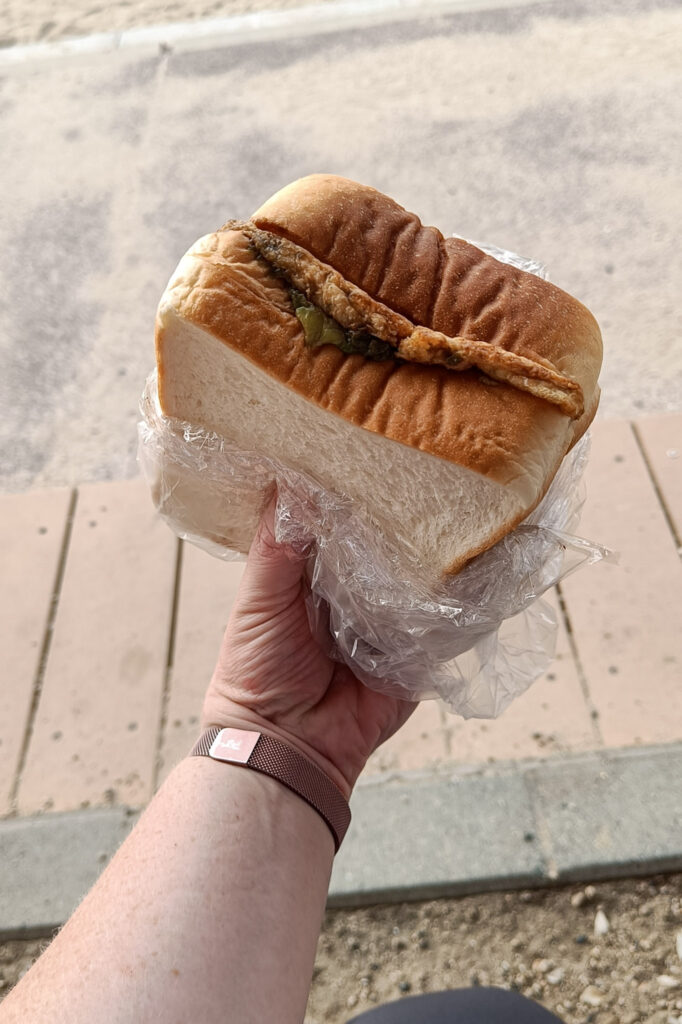
My Go-To Packed Lunch in Japan
One of the best discoveries I’ve had in Japan is abura-age. This is fried, sliced tofu, usually sold in long slabs. You’ll find it near the fruit and veg section, around other blocks of tofu.
Throw it in a frying pan with a bit of soy sauce and it’s delicious, almost like a vegan omelette. I like to mash up avocado with soy sauce and chilli flakes if I have them, then spread it on bread, placing the abura-age on top.
It keeps well, and it’s easy to transport – just stick it in a ziploc bag or some kind of wrap and you’re good to go. Sure, it might get a bit squashed by the time you sit down for lunch, but it’s still going to be delicious, and a good balance of protein, healthy fats and carbs.
On-Route Refuelling
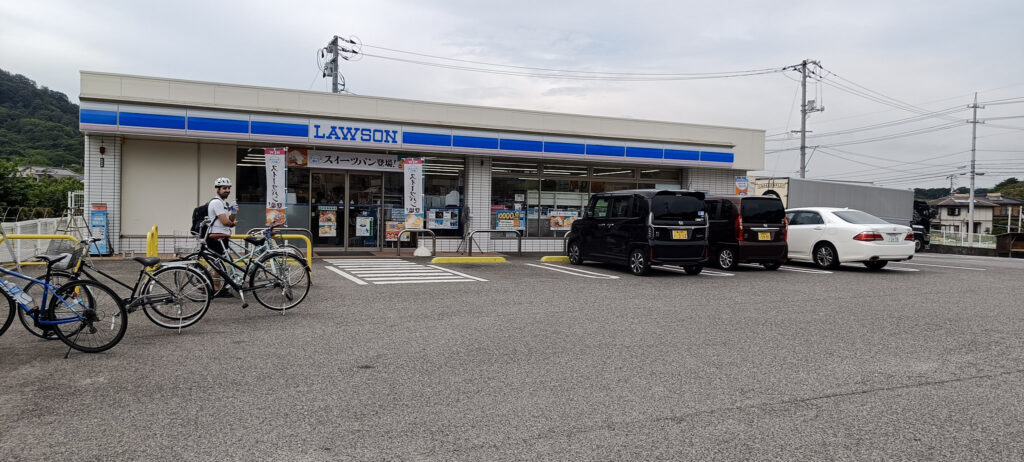
The Konbini Pitstop
There are convenience stores, konbini, everywhere in Japan and on the Shimanami Kaido, you’ll find at least one on each island. If you’ve stocked up well in Onomichi, you’ll probably only need to stop for snacks or water refills, but it’s worth knowing what you can have or not as a vegan.
This guide from The Japanese Rose to vegan konbini stores is wonderfully comprehensive and includes a guide on ingredients and their translations.
Ahead of time, bookmark the konbini along the route and save in offline maps.

Staying Hydrated
On your cycle, the humidity along the Seto Inland sea and the effort you’re making on the bike means you’re sweating out more than just water. Your body is losing salts and minerals, and keeping these replenished helps keep the fatigue down.
Bring some electrolyte tablets along with you and take one or two in your water on the journey (I like these ones). If you don’t have these, then a bottle of Pocari Sweat or Aquarius from a konbini can give you a boost.
I’ve mentioned this in the Packing Guide, and I’ll say it again: You do not need to bring two litres of water on your back. There are vending machines literally everywhere, and many places to refill a water bottle such as konbini or cafes on the route.
Breakfast and Lunch
Eat a hearty breakfast before you set off. Even if you’re not normally a breakfast person, it’s worth getting up a little earlier to make sure you have a proper meal. In my case, that was leftover curry udon and tofu – not exactly what I’d choose most mornings, but hey, it had protein.
For lunch, aim to time this about halfway through your cycle, but listen to your body if you’re feeling fatigued and hungry. There are plenty of lookout spots with benches along the routes, especially on the way up to the bridges so it’s easy to find somewhere to pause and eat your packed lunch.
Tip:
Like most of Japan, you’re not going to see a lot of trash cans or bins along the Shimanami Kaido. Bring a plastic bag to put rubbish or dirty lunch containers in.
What I’d do differently
On our first day cycling, we were well fuelled with our packed abura-age and avocado sandwihes, but we stopped too late and rested too long at Sunset Beach on Ikuchi Island. That made the last hour much harder.
My real mistake was on Day 2. We’d only bought enough in Onomichi to cover dinner the night before and food for Day 1, wanting to keep our bags light. We didn’t anticipate getting into Omishima so late, and by that point, we only had the energy for a konbini stop before making our way to the airbnb for the night.
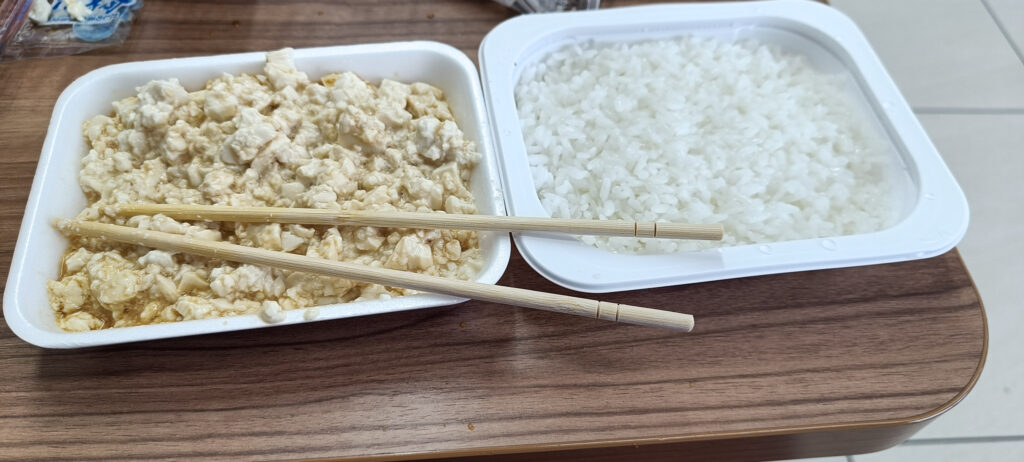
On the second day, we stopped at a konbini where I made a makeshift lunch of microwaved rice and silken tofu (and naturally my husband “didn’t want any” when I was buying it, but immediately tucked in when offered).
This second day was a miserable, rainy day, so having a tastier lunch would have made it a lot more pleasant!
If I was to do it again, I’d stock up with more tofu and more ingredients for abura-age sandwiches for Day 2. Do the heavy lifting once in Onomichi to guarantee you’ve got a good, protein-rich meal for both days.
Dinner and Accommodation
The Traditional Ryokan Inn
Staying in a ryokan or even a smaller hotel often includes dinner and breakfast. This can be a beautiful, traditional experience like the one I had in Hakone, but it’s a risky choice for a vegan Shimanami Kaido cyclist.
As I outlined in my Hakone post, finding a vegan-friendly ryokan is a challenge, and even then it’s not always guaranteed that your food won’t have fish stock or bonito flakes.
I’d advise against a ryokan as during a vegan Shimanami Kaido trip, but if it’s a must-do for you or you’re travelling with a group, contact the ryokan as early as possible (ie. weeks not days) to confirm if they can provide a full vegan meal. If the answer is no, see if you can opt out of the meal plan and eat the food you’ve brought.
This is where my Huel trick can be really helpful – it’s not exactly gourmet, but it’s better than having beer and a pack of pistachio nuts for dinner. (And trust me on that one, that was my dinner one night in Uzbekistan.)
Airbnb
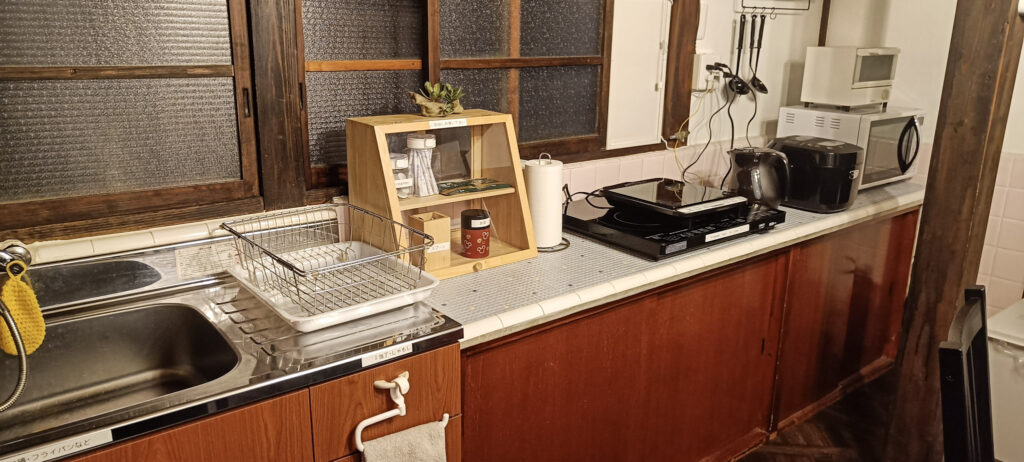
Booking an Airbnb is my strong recommendation for a vegan doing this cycle. Check the listing before booking to make sure there is a kitchen or cooking appliances. This is what we did, and it made it so much easier for us.
If you’ve been smarter than I have and brought food from Onomichi, you can cook it in your Airbnb. Otherwise, you can do what we did and grab some food from the konbini. The selection isn’t great, but you can make do.
We grabbed a couple of blocks of silken tofu, some pre-chopped cabbage, an onion, soy sauce, and microwavable rice. It wasn’t anything fancy, but we were grateful for an easy dinner after a long day on the bike.
We’d bought enough to make 4 portions, so we had leftovers for breakfast before setting off.
If you’re still deciding where to stay overnight, you may find my post on Shimanami Kaido accommodation helpful.
The End of the Line
Ending in Imabari, you’re back in a city and there are a couple vegan options. From what we saw, the dedicated vegetarian restaurants were either quite far out of the city or closed quite early.
The best option we found was a Coco Ichibanya near our hotel. They’ve got a couple of veggie curries that are marked as vegan friendly. If you go, a word of advice: take the spiciness scale seriously. Japan is not especially famous for spicy food, so I thought a 7 out of 20 would be grand. It was not. I can usually handle spice quite well, but this one had asking for three refills of our pitcher of water. I staggered out of there like I’d just been kicked out of a nightclub: red eyed, hiccupping, and full of liquid.
Final Thoughts
Planning your meals for a vegan Shimanami Kaido adventure does mean more effort than a typical trip, but trust me, that effort pays off. By putting in the time upfront to plan your meals and make sure you’ve got the food storage gear you need, you’re setting yourself up well for a truly amazing experience.
Ahead of time, we’d searched for vegan friendly cafes and restaurants, and while they exist, there aren’t that many of them and they’re not always immediately along the route.
Depending on how often you stop, sights you want to see and rests you want to take, your cycle may also take you longer than expected. Because of this, we chose to rely on packed lunches, protein bars, and konbini stops to keep us going.
While the food might have been basic, the views were incredible and it was such a great feeling to get to the end and think “I did that!”. Given how great the food was on other legs of our Japan trip, it’s a small price to pay.
So to you, my fellow vegan, I’ll leave you with this: prioritise Airbnbs with kitchens, plan meals well, load up on protein, and have the absolute best time.
This post is part of a series on the Shimanami Kaido, you’ll find the full guide here, covering everything I wish I’d known.